
One of the most common questions after an accident is also one of the hardest to answer: “How long will my injury settlement take?”
The honest answer is that there is no single Texas settlement timeline for every injury claim. Some claims resolve in a few months after medical care is complete and records are organized. More serious or disputed claims can take much longer, especially when treatment is ongoing, fault is contested, policy limits are unclear, liens must be resolved, or a lawsuit becomes necessary.
A settlement should not be rushed just because bills are arriving. It also should not drift without direction while evidence disappears and deadlines move closer.
This guide explains the stages that affect injury settlement timing in Texas, what can speed up or slow down the process, and what San Antonio accident victims can do to keep the claim organized.
Quick Answer
An injury settlement in Texas may take several months or longer depending on the injury, medical treatment, fault dispute, insurance coverage, available evidence, settlement negotiations, liens, and whether a lawsuit is needed. A simple claim with clear fault, completed treatment, organized medical records, and cooperative insurance may resolve faster. A serious injury claim, commercial vehicle case, disputed fault claim, uninsured/underinsured claim, or lawsuit can take much longer.
If you were injured in San Antonio and the settlement timeline is unclear, speaking with san antonio injury lawyers may help you understand what stage the claim is in, what records are missing, and what Texas deadlines may apply.
Key Takeaways
- There is no guaranteed settlement timeline for every Texas injury claim.
- The claim usually cannot be valued properly until the injury, treatment plan, medical bills, wage loss, and future-care needs are reasonably clear.
- Insurance timelines depend partly on whether the claim is against your own insurer or another driver’s insurer.
- Texas law sets claim-handling deadlines for your own insurer after you file a claim, but the prompt-payment law does not apply the same way when another driver’s insurer is paying.
- Settlement timing may slow down because of disputed fault, treatment gaps, missing records, policy limits, liens, releases, uninsured drivers, commercial vehicles, or litigation.
- Texas injury claims are time-sensitive, so settlement talks should be managed with the legal deadline in mind.
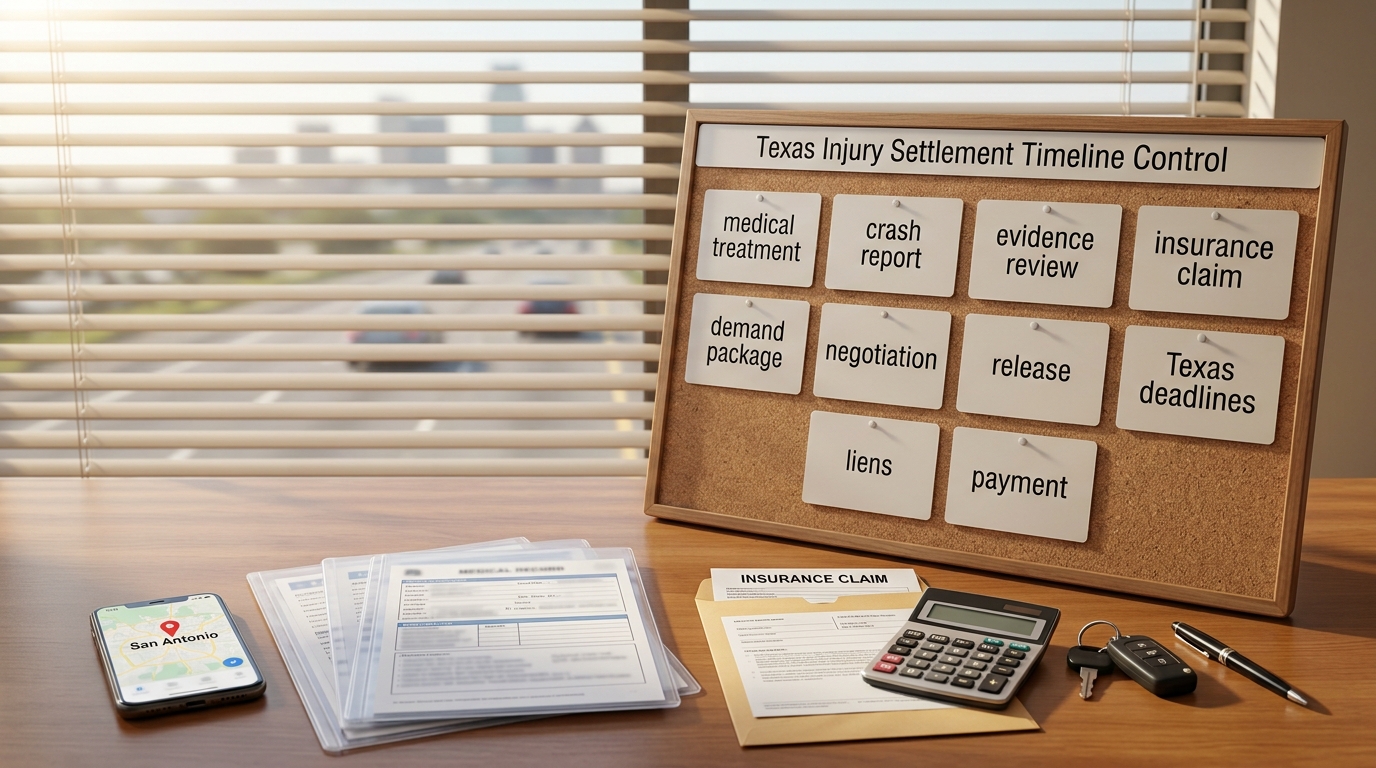
The Settlement Timeline Control Board
A settlement is not one event. It is a sequence of stages.
Use this control board:
| Stage | What Usually Happens |
| Stage 1 | Emergency response, medical care, and safety |
| Stage 2 | Crash report, photos, witnesses, and evidence |
| Stage 3 | Insurance notice and claim setup |
| Stage 4 | Medical treatment and recovery tracking |
| Stage 5 | Records, bills, wage loss, and repair documents |
| Stage 6 | Demand package and insurance evaluation |
| Stage 7 | Negotiation, coverage review, and settlement discussions |
| Stage 8 | Release review, liens, payment, and closing |
| Stage 9 | Lawsuit path if settlement does not happen |
The settlement clock does not really start just because the crash happened. In many claims, the meaningful settlement timeline starts after the injured person has enough medical and financial documentation to evaluate the claim.
Stage 1: The First Days After the Accident
The first days after an accident are usually not about settlement. They are about safety, medical care, and preserving proof.
Important first steps include:
- Calling police if someone is injured or a driver leaves
- Getting medical care
- Photographing vehicles, injuries, hazards, and the scene
- Collecting driver and insurance information
- Saving witness names and phone numbers
- Looking for nearby cameras
- Reporting the accident to insurance
- Getting the adjuster’s contact information
- Saving medical records and bills
The Texas Department of Insurance recommends taking photos, talking to witnesses, writing down accident details, reporting the wreck, getting the adjuster’s contact information, and keeping medical records and bills if you saw a doctor.
These early steps affect settlement timing because missing evidence creates delays later.
Stage 2: Waiting for the Crash Report and Key Records
A crash report may help document the accident date, time, location, drivers, vehicles, insurance information, reported injuries, witnesses, citations, contributing factors, and officer observations.
For San Antonio crashes, SAPD open-records materials say police records requests may include crash or vehicle accident reports, calls for service, towing records, 911 calls, body camera footage, and dash camera footage. SAPD also notes that crash reports are available through TxDOT’s system and can take time to appear.
TxDOT is the custodian of Texas crash records and provides eligible requesters access to Texas Peace Officer’s Crash Reports through the Crash Report Online Purchase System.
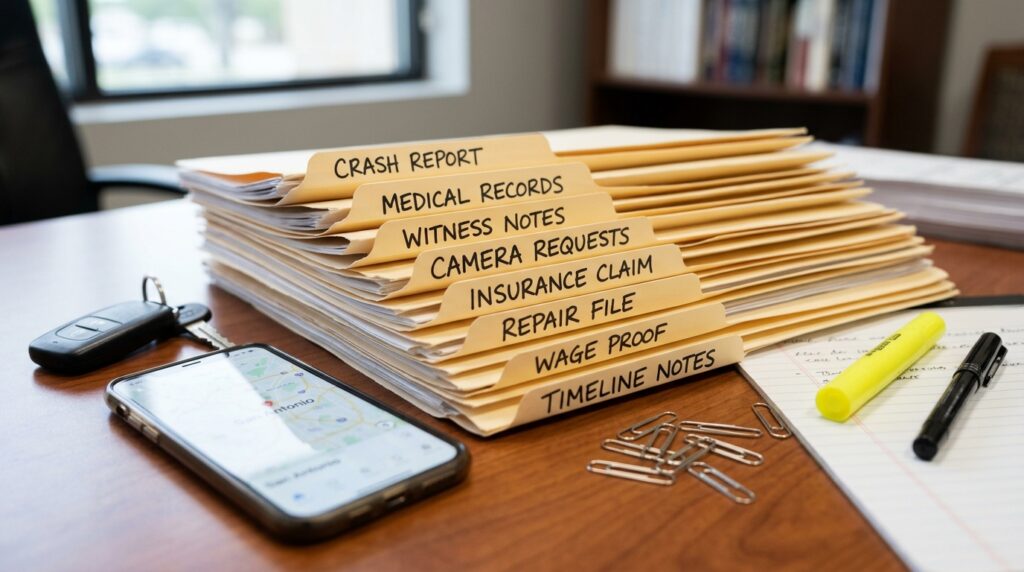
Save:
- Report number
- Responding agency
- Officer name, if known
- Crash date and time
- Crash location
- Driver information
- Insurance information
- Witness names
- Citation information
- Notes about how the report was requested
A missing crash report does not always stop a claim, but it can delay evaluation if the insurer is waiting to confirm facts.
Stage 3: Insurance Claim Setup
Insurance claim setup can happen quickly, but claim evaluation takes longer.
You may be dealing with:
- Your own auto insurer
- The other driver’s insurer
- A commercial carrier
- A rideshare insurer
- A property insurer
- A health insurer
- UM/UIM coverage
- PIP or medical payments coverage
- Collision coverage
- Rental coverage
Your own insurance policy may have claim-reporting deadlines, so it is usually important to notify your insurer promptly.
Insurance setup usually includes:
- Claim number
- Adjuster assignment
- Initial recorded facts
- Vehicle inspection
- Repair estimate
- Coverage review
- Medical-record requests
- Liability review
- Property-damage handling
Keep a claim log with the adjuster’s name, insurance company, phone number, email address, date of each call, and what was discussed.
Stage 4: The Medical Treatment Period
Medical treatment is often the biggest factor in settlement timing.
A claim may be difficult to settle fairly while the injured person is still treating, still waiting for imaging, still seeing specialists, or still unsure whether future care is needed.
Medical timing issues may include:
- Emergency care
- Urgent care
- Primary care visits
- Imaging
- Specialist referrals
- Physical therapy
- Pain management
- Surgery recommendations
- Follow-up appointments
- Work restrictions
- Maximum medical improvement
- Future care opinions
- Permanent impairment concerns
If treatment is ongoing, the settlement value may still be unclear. Settling too early can create risk because a settlement release may end the claim before future medical needs are known.
Stage 5: Medical Bills, Records, and Wage Proof
Even after treatment stabilizes, settlement may take time because records must be collected and organized.
Important documents include:
- Medical records
- Medical bills
- Imaging reports
- Prescription receipts
- Referral paperwork
- Therapy attendance records
- Work restriction notes
- Pay stubs
- Timesheets
- Employer letters
- Repair estimates
- Rental receipts
- Towing bills
- Storage bills
- Out-of-pocket receipts
- Recovery journal notes
Medical providers and billing offices may respond at different speeds. Bills may also be revised, supplemented, adjusted by insurance, or tied to liens and reimbursement claims.
Settlement talks are stronger when the demand is based on complete records rather than estimates.
Stage 6: The Demand Package
A settlement demand package usually explains the accident, liability, injuries, medical treatment, medical bills, lost wages, future care, pain and daily-life impact, and requested settlement amount.
A strong demand package may include:
- Accident summary
- Liability evidence
- Crash report or incident report
- Photos and videos
- Witness information
- Medical records
- Medical bills
- Treatment timeline
- Wage-loss documents
- Repair or property damage records
- Policy-limit concerns
- Future-care information
- Settlement demand amount
- Response deadline
The insurance company may take time to review the demand, request more information, compare records, evaluate coverage, and decide whether to offer settlement authority.
Stage 7: Insurance Evaluation and Claim-Handling Timing
Texas insurance timing can be confusing because different rules may apply depending on whose insurance company is handling the claim.
When you file a claim with your own insurance company, Texas law sets claim-handling deadlines. TDI explains that an insurer must acknowledge it received your claim within 15 days after notice, may request more information, must accept or reject the claim within 15 business days after receiving all needed information, may take 45 more days if it needs more time and explains the delay, and must send payment within five business days after agreeing to pay.
However, TDI also explains that the prompt-payment law does not apply if another driver’s insurance company is paying the claim, though the company must act in good faith and try to settle quickly and fairly.
That distinction matters. If you are dealing with the at-fault driver’s insurer, the timeline may depend heavily on liability review, coverage investigation, policy limits, medical documentation, settlement negotiations, and whether the insurer disputes the claim.
Stage 8: Negotiation
Negotiation can be quick or slow depending on the dispute.
A settlement may move faster when:
- Fault is clear
- Medical treatment is complete
- Bills are organized
- Wage loss is documented
- Coverage is confirmed
- The insurer has enough information
- There are no major liens
- The injured person understands the release
A settlement may move slower when:
- Fault is disputed
- The insurer blames the injured person
- Medical treatment is ongoing
- Future care is uncertain
- The insurer disputes bills
- There are prior injury arguments
- Witnesses are missing
- Camera footage must be preserved
- Policy limits are low
- Multiple insurers are involved
- A commercial vehicle or rideshare vehicle is involved
- A government entity may be involved
Negotiation is not only about the amount. It is also about timing, proof, coverage, release language, and whether settlement would actually resolve the full claim.
Stage 9: Settlement Releases
A settlement release can be the final legal step before payment. It is important because it usually ends the claim.
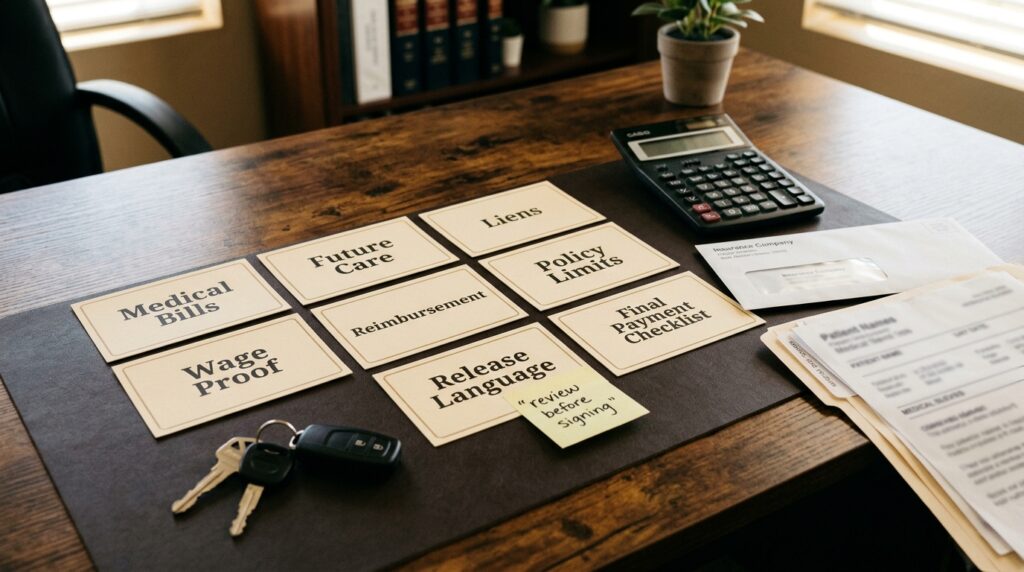
Before signing a release, ask:
- Are all medical bills included?
- Is treatment complete?
- Is future care expected?
- Are lost wages included?
- Are repair or rental issues separate?
- Are liens or reimbursement claims possible?
- Does the release include all claims?
- Does it release only one party or multiple parties?
- Does it include unknown injuries?
- Is the payment final?
- Does it affect UM/UIM claims?
- Does it affect property damage claims?
TDI warns that when another driver’s insurer offers a medical settlement, the company will also ask the injured person to sign a release promising not to file more claims for the accident. Before signing, TDI recommends talking to a doctor about future medical treatment and considering whether the offer is fair.
Stage 10: Liens, Reimbursement, and Final Payment
Even after settlement is agreed, payment may not be immediate if liens or reimbursement claims need review.
Possible post-settlement issues include:
- Health insurance reimbursement
- Medicare or Medicaid questions
- Hospital liens
- Provider balances
- Letter-of-protection balances
- Workers’ compensation reimbursement
- PIP or MedPay coordination
- Child support liens, in some situations
- Medical bill reductions
- Settlement check processing
- Release paperwork
- Attorney fee and cost accounting, if represented
This final stage can surprise people. The settlement amount and the final take-home amount may not be the same.
A clear closing statement should explain the settlement, deductions, liens, fees, costs, reimbursements, and final distribution.
What Can Speed Up an Injury Settlement?
Some factors can help settlement move more efficiently.
Helpful steps include:
- Getting medical care promptly
- Following treatment instructions
- Keeping appointments
- Saving all medical records and bills
- Photographing the scene and damage
- Preserving witness information
- Tracking the crash report
- Keeping an insurance call log
- Documenting wage loss
- Saving repair and rental records
- Avoiding social media posts about the claim
- Avoiding contradictory statements
- Identifying all insurance coverage early
- Asking about liens before settlement
- Reviewing release language carefully
A settlement can still take time, but organized proof reduces avoidable delays.
What Can Slow Down an Injury Settlement?
Common delay factors include:
- Ongoing medical treatment
- Surgery recommendations
- Future-care uncertainty
- Missing medical records
- Missing bills
- Treatment gaps
- Disputed fault
- Shared-fault arguments
- Witness problems
- Missing camera footage
- Low policy limits
- Uninsured or underinsured drivers
- Hit-and-run crashes
- Commercial vehicle records
- Rideshare insurance issues
- Multiple injured people
- Liens and reimbursement claims
- Government entity involvement
- Litigation
- Disputes over release language
A slow settlement is not always a bad sign. Sometimes delay happens because the injury needs time to be understood. But delay without a plan can hurt the claim.
San Antonio Accident Settings That Affect Settlement Timing
Settlement timing may depend on where and how the accident happened.
Freeway and Loop Crashes
Crashes on I-35, I-10, Loop 410, Loop 1604, US 281, and nearby ramps may involve high speeds, multi-vehicle impacts, lane-change disputes, commercial vehicles, hit-and-run drivers, or serious injuries.
These claims may take longer because fault and damages require more records.
Downtown, River Walk, Pearl, Medical Center, and Airport-Area Crashes
Dense areas may involve pedestrians, rideshare pickups, scooters, delivery drivers, business cameras, parking garages, buses, and complex witness issues.
These claims may require camera requests, incident reports, and detailed location evidence.
Parking Lots, Apartments, Stores, and Restaurants
Parking-lot and property-adjacent claims may involve unclear right-of-way, backing vehicles, poor lighting, spills, broken pavement, missing warnings, or surveillance footage.
These claims may slow down if property owners delay incident reports or video evidence.
Commercial, Truck, and Delivery Vehicle Claims
Commercial vehicle claims may require company records, maintenance records, driver files, dispatch logs, delivery documents, and multiple insurance policies.
These claims often take longer than standard passenger-car claims. So a professional is needed like a truck injury lawyer for truck related claims.
Does Filing a Lawsuit Mean Settlement Is Impossible?
No. Many cases still settle after a lawsuit is filed. Litigation can create a more formal process for exchanging evidence, taking depositions, using experts, filing motions, mediating, and preparing for trial.
A lawsuit may become necessary when:
- The insurer denies liability
- The settlement offer is too low
- The deadline is approaching
- Evidence must be obtained formally
- The insurer disputes medical causation
- Policy limits are contested
- Multiple parties blame each other
- A commercial entity refuses records
- A government entity may be involved
- Settlement talks stall
Filing a lawsuit may extend the timeline, but it can also create pressure and structure when negotiation alone is not working.
Texas Deadlines Still Matter During Settlement Talks
Settlement discussions do not automatically stop legal deadlines.
In many Texas injury cases, a personal injury lawsuit must be brought not later than two years after the day the cause of action accrues under Texas Civil Practice and Remedies Code Section 16.003.
Texas also has proportionate-responsibility rules. Under Texas Civil Practice and Remedies Code Section 33.001, a claimant may not recover damages if their percentage of responsibility is greater than 50 percent.
Some cases may involve shorter notice issues, especially if a government vehicle, public employee, roadway condition, or public entity may be involved.
Because settlement talks can take time, the deadline should be tracked from the beginning.
How to Know Whether the Timeline Is Reasonable
Ask practical questions:
- Is medical treatment still ongoing?
- Are future-care needs clear?
- Are medical records complete?
- Are bills complete?
- Has the crash report been obtained?
- Is fault disputed?
- Has the insurer confirmed coverage?
- Are policy limits known?
- Are liens identified?
- Has a demand package been sent?
- Has the insurer responded?
- Is the offer supported by the evidence?
- Are deadline risks being tracked?
- Has release language been reviewed?
If the answer to most of these questions is “no,” the claim may not be ready for settlement yet.
San Antonio Injury Settlement Timeline Checklist
Use this checklist to track progress.
Early Claim Stage
- Accident reported
- Medical care started
- Photos saved
- Witnesses identified
- Crash report requested
- Insurance claim opened
- Adjuster contact saved
Medical Documentation Stage
- Treatment plan known
- Imaging completed, if needed
- Specialist records collected
- Therapy records collected
- Work restrictions saved
- Medical bills requested
- Future-care questions reviewed
Demand Stage
- Liability evidence organized
- Medical records complete
- Wage loss documented
- Repair/rental records saved
- Policy limits reviewed
- Demand package prepared
- Response deadline tracked
Negotiation Stage
- Insurer response received
- Missing information addressed
- Counteroffers tracked
- Liens reviewed
- Release language reviewed
- Settlement terms confirmed
Closing Stage
- Release signed only after review
- Liens/reimbursement addressed
- Payment timing confirmed
- Final settlement statement reviewed
- Claim documents saved
FAQ
How long do injury settlements take in Texas?
It depends. Some claims may resolve in a few months after treatment is complete and records are organized. Serious, disputed, underinsured, commercial vehicle, or litigated claims can take much longer.
Why does medical treatment affect settlement timing?
A claim may be undervalued if it settles before treatment is complete or future care is known. Medical records, bills, restrictions, and prognosis help establish value.
Does the insurance company have a deadline to respond?
When you file a claim with your own insurer, Texas law sets claim-handling deadlines. TDI explains that the insurer must acknowledge the claim within 15 days, accept or reject within 15 business days after receiving all needed information, may take 45 more days if it needs more time and explains why, and must send payment within five business days after agreeing to pay.
Do the same deadlines apply to the other driver’s insurer?
Not in the same way. TDI explains that the prompt-payment law does not apply if another driver’s insurance company is paying the claim, though the company must act in good faith and try to settle quickly and fairly.
Should I settle before I finish medical treatment?
Be careful. A settlement release may end the claim. Before signing, consider whether treatment is complete, future care is expected, all bills are included, and wage losses are known.
What slows down a Texas injury settlement?
Common delays include disputed fault, ongoing treatment, missing records, policy-limit issues, liens, uninsured drivers, commercial vehicles, litigation, and disagreements over release language.
Can a lawsuit still settle?
Yes. Many injury cases settle after a lawsuit is filed. Litigation may create a formal process for obtaining evidence and resolving disputes.
How long do I have to file a personal injury lawsuit in Texas?
In many Texas injury cases, the general deadline is two years after the cause of action accrues. Some claims may involve shorter notice rules or different deadlines.
What if the insurer says I was partly at fault?
Texas shared-fault rules can reduce or prevent recovery depending on your percentage of responsibility. Evidence is especially important when fault is disputed.
Is this article legal advice?
No. This article is for general informational purposes only. Anyone dealing with a specific accident or injury claim should speak with a qualified legal professional about their situation.
Final Thoughts
Texas injury settlements take time because settlement value depends on proof. The claim needs medical records, bills, wage documentation, evidence, insurance review, negotiation, release review, and sometimes lien resolution or litigation.
The best approach is not to rush blindly or wait passively. Build a settlement timeline control board. Track records, treatment, insurance responses, policy limits, liens, releases, and Texas deadlines so you know whether the claim is moving—or simply drifting.
