
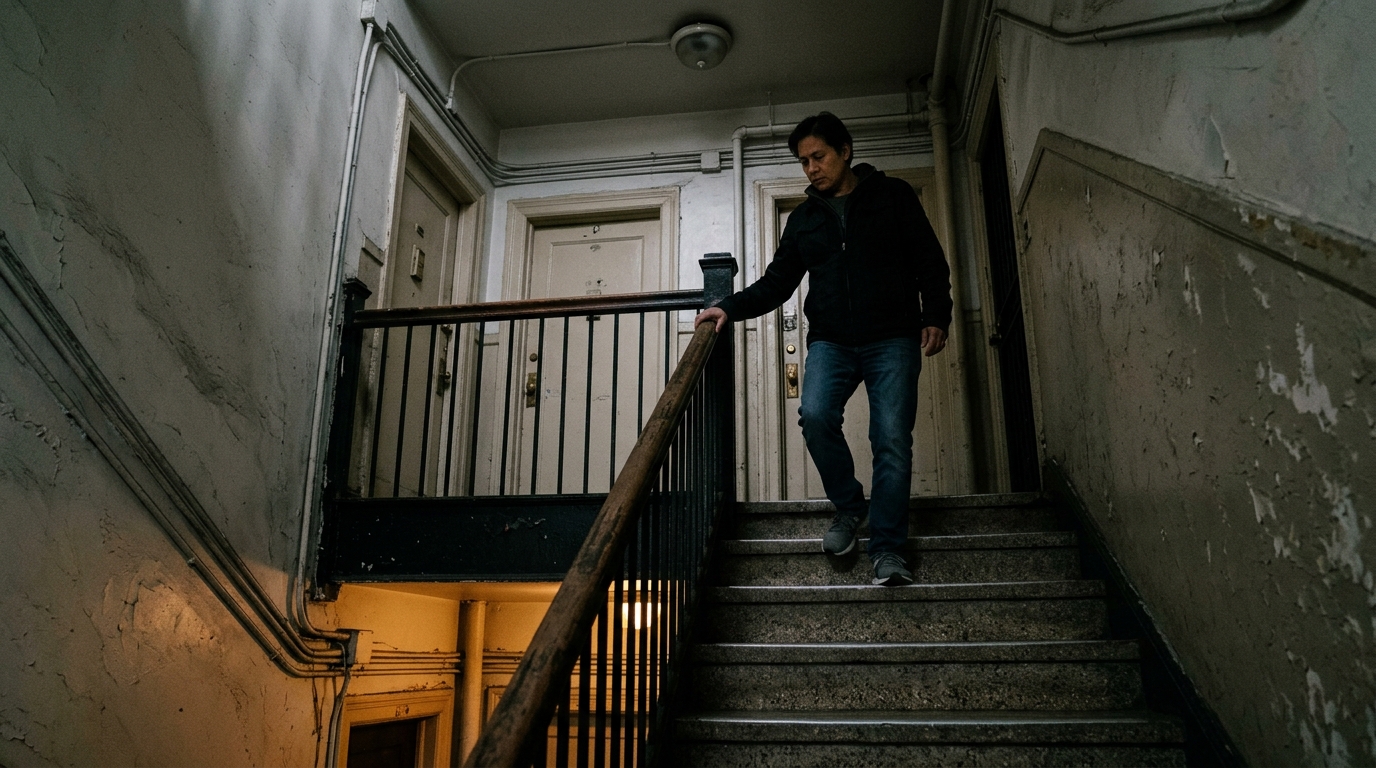
Inadequate lighting can create dangerous conditions in apartment buildings, stairways, parking garages, sidewalks, and commercial properties. Poor visibility may prevent someone from noticing a broken step, uneven surface, or unexpected obstruction, increasing the risk of serious injuries.
In New York, property owners and other responsible parties may be liable when negligent lighting maintenance causes or contributes to an accident. Establishing a claim generally requires evidence of the unsafe condition, the defendant’s legal responsibility, and the connection between inadequate lighting and the resulting injuries.
Quick Answer
Can someone sue a property owner for injuries caused by inadequate lighting in New York?
Yes. An injured person may have grounds to pursue compensation when inadequate lighting contributes to an accident and a property owner, landlord, management company, or another responsible party breaches an applicable duty of care.
Examples include falls on poorly illuminated staircases, trips over obstacles in dark hallways, and injuries caused by hidden pavement defects in parking areas. However, insufficient lighting does not automatically establish liability. The claimant must demonstrate negligence, causation, and legally compensable damages.
Key Takeaways
- Property Maintenance: Owners and parties controlling premises generally must maintain reasonably safe conditions, including lighting where required.
- Common Hazards: Poorly illuminated stairs, hallways, parking garages, entrances, and outdoor walkways may increase accident risks.
- Lighting Laws: New York’s Multiple Dwelling Law and local regulations establish specific illumination requirements for certain properties.
- Notice Requirements: Liability often depends on whether the responsible party created the lighting problem or had actual or constructive notice.
- Evidence: Photographs, lighting measurements, maintenance requests, surveillance footage, and witness testimony may support a claim.
- Shared Fault: New York’s comparative negligence rules may reduce compensation when the injured person’s conduct contributed to the accident.
- Legal Deadlines: Most ordinary personal injury lawsuits have a three-year filing period, while certain government-related claims involve shorter deadlines.
What Is an Inadequate Lighting Injury Claim?
An inadequate lighting injury claim is a premises liability case involving an accident that was caused or made more likely by insufficient illumination.
These accidents often involve a combination of poor visibility and another dangerous condition.
For example, a person may trip over a raised floor tile because a poorly maintained hallway light makes the defect difficult to see. Another person may fall down an apartment staircase when defective lighting prevents them from identifying the edge of a step.
The legal issue is whether the lighting condition made the premises unreasonably dangerous under the circumstances and whether a responsible party negligently created or failed to address that condition.
Accidents Caused by Poor Visibility
Some accidents occur because a person cannot clearly identify the walking surface.
Examples include missing a step, walking into an obstruction, or misjudging a change in elevation.
A claimant generally must establish that inadequate illumination contributed to the accident rather than merely showing that the surrounding area was dark.
Accidents Involving Multiple Property Defects
Other incidents involve several hazards acting together.
For example, a staircase may have a damaged handrail and inadequate lighting. A person may stumble because they cannot see a worn step and then be unable to regain balance because the railing is unstable.
In these cases, the claimant may need to show how the combined conditions contributed to the fall.
Poor lighting does not necessarily have to be the only cause of an injury to be legally relevant.
Where Do Inadequate Lighting Accidents Commonly Occur?
Lighting-related accidents may occur on residential, commercial, or publicly controlled properties.
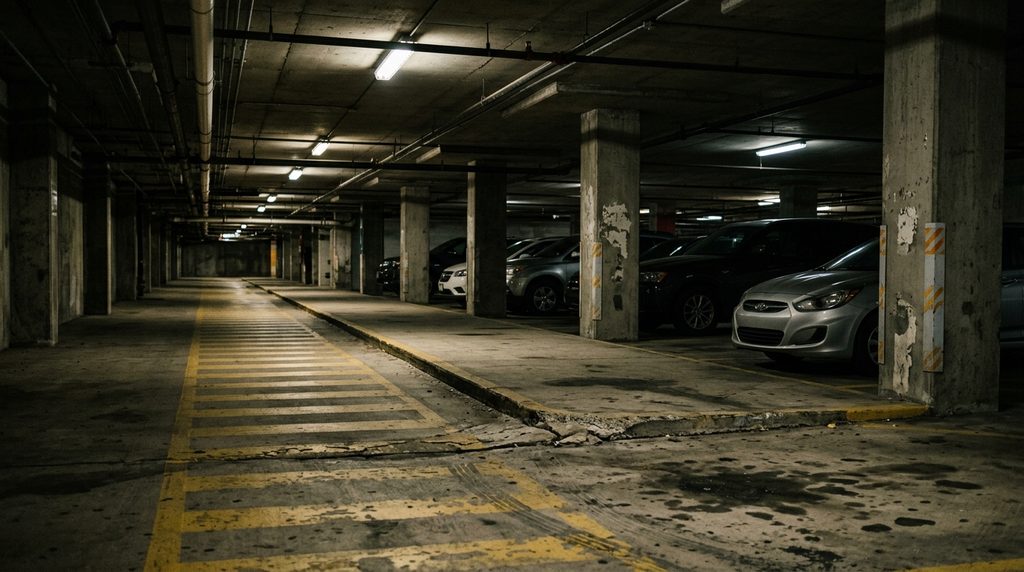
Different locations can involve different maintenance responsibilities and safety requirements.
Apartment Building Staircases
Staircases are especially sensitive to inadequate lighting because people must repeatedly judge changes in elevation.
Potential hazards include:
- Burned-out stairway bulbs
- Malfunctioning overhead fixtures
- Poorly illuminated landings
- Dark areas between flights
- Lights that repeatedly flicker or fail
- Shadows concealing damaged steps
- Insufficient lighting near handrails
- Broken fixtures that remain unrepaired
A poorly illuminated stairway can become particularly dangerous when combined with loose carpeting, uneven steps, or missing handrails.
Residential Hallways and Entrances
Apartment hallways and entrances are frequently used by residents, visitors, and delivery personnel.
Inadequate lighting may make it difficult to recognize wet floors, raised flooring edges, or other hazards.
A recurring lighting problem may become relevant when tenants have previously complained to management.
The investigation may focus on the duration of the defect, the property’s maintenance procedures, and whether the responsible party acted reasonably.
Parking Garages and Parking Lots
Parking facilities may contain pedestrian walkways, ramps, staircases, and entrances with limited natural lighting.
Common problems include:
- Malfunctioning overhead fixtures
- Dark pedestrian access routes
- Uneven concrete concealed by shadows
- Poorly illuminated parking garage stairs
- Obstacles near parked vehicles
- Inadequate visibility near floor-level changes
An injured person may have difficulty identifying a pothole, parking barrier, or uneven walking surface.
However, liability depends on whether the operator owed and breached a duty concerning the specific location.
Commercial Buildings
Shopping centers, restaurants, hotels, office buildings, and retail establishments may have lighting-related hazards.
For example, a restaurant may have a poorly illuminated staircase leading to a lower level, or an office building may have a dark entrance with an unexpected elevation change.
A business or property owner controlling the area may have relevant safety and maintenance duties.
Outdoor Walkways and Sidewalks
Outdoor pedestrian areas may become hazardous when insufficient illumination combines with damaged pavement, landscaping obstacles, or uneven surfaces.
A property owner may have responsibility for maintaining a walkway under its control.
However, the absence of street lighting on a public sidewalk does not automatically establish municipal liability.
Whether a government entity owes a particular lighting duty depends on applicable law and the circumstances.
What Legal Duties Do New York Property Owners Have Regarding Lighting?
New York property owners and parties controlling premises generally have a duty to maintain reasonably safe conditions under the circumstances.
This duty may include maintaining existing lighting systems, correcting known defects, and providing illumination where applicable laws require it.
However, property owners are not automatically responsible whenever an accident occurs in a dimly illuminated area.
The relevant question is whether reasonable care or an applicable legal requirement was violated.
Maintaining Functional Lighting Systems
When an owner or operator controls a building’s common areas, reasonable maintenance may include replacing failed bulbs, repairing defective fixtures, and correcting recurring electrical problems.
The nature of the area and foreseeable risk of injury may influence what reasonable care requires.
A dark staircase may create different safety concerns from a landscaped area that is not intended for pedestrian use.
Responding to Reported Lighting Problems
A landlord may receive complaints that a stairwell light has stopped working.
Such complaints can become evidence that the landlord had actual notice of the condition.
The timing of the report, severity of the hazard, and opportunity to correct it are important considerations.
Conducting Reasonable Inspections
Building operators may use inspection schedules to identify malfunctioning lights.
However, general statements about routine maintenance may not establish that the actual accident location was inspected.
Inspection logs, repair records, and employee testimony may provide more useful information.
Providing Lighting Required by Law
Certain residential buildings are subject to specific statutory illumination requirements.
Other types of properties may be governed by applicable building codes or safety regulations.
The correct standards depend on location, property classification, occupancy, and other circumstances.
What New York Laws Address Inadequate Building Lighting?
Several New York laws establish lighting requirements for covered residential buildings.
Their applicability depends on the building’s classification and location.
New York Multiple Dwelling Law § 37
New York Multiple Dwelling Law § 37 addresses artificial lighting in covered multiple dwellings.
It requires owners to provide lighting or equivalent illumination in specified vestibules, entrance halls, public halls, stairs, fire stairs, and fire towers.
The law generally requires designated lights to remain on from sunset until sunrise.
Certain fire stairs, fire towers, stairways, and public halls without windows opening to outside air must remain illuminated continuously, subject to statutory provisions.
The law also contains qualifications relating to fixtures becoming extinguished without the owner’s knowledge or consent.
The New York Multiple Dwelling Law § 37 provides the statutory requirements.
New York Multiple Dwelling Law § 78
Section 78 establishes general repair obligations for covered multiple dwellings.
It generally requires relevant portions of these buildings to remain in good repair.
When malfunctioning lighting equipment presents a dangerous condition, the repair obligations may become relevant.
However, whether a violation establishes liability depends on the applicable legal duties, circumstances, and causation.
New York City Housing Maintenance Code § 27-2038
New York City imposes specific illumination standards for certain residential common areas.
Under Administrative Code § 27-2038, covered multiple dwellings and tenant-occupied two-family dwellings must generally maintain illumination of at least one foot-candle measured at floor level throughout designated public hallways, stairs, fire stairs, and fire towers.
The required level generally applies during both daytime and nighttime.
The provision also addresses lighting in common laundry rooms during occupancy and continuous fixture operation in specified enclosed areas.
A foot-candle is a unit used to measure the amount of light reaching a surface.
The NYC Housing Maintenance Code lighting provision provides the detailed requirements.
These New York City rules should not automatically be applied to properties elsewhere in New York State.
Do All Buildings Have the Same Lighting Requirements?
No.
Apartment buildings, commercial properties, parking structures, private homes, and public facilities may be governed by different rules.
Building age, occupancy, construction history, and local regulations can also affect the applicable requirements.
A standard governing a residential stairwell does not automatically establish the required lighting level for an outdoor walkway.
Does Violating a Lighting Code Automatically Establish Liability?
Not necessarily.
A relevant statutory violation may provide evidence of negligence, but a claimant still generally must establish that the provision applies and that the violation contributed to the injury.
For example, a lighting fixture may fail to meet an applicable standard, but the evidence must connect the resulting visibility problem to the fall.
The legal effect of a violation depends on the type of law and circumstances.
Who Can Be Liable for an Inadequate Lighting Accident?
Liability generally depends on who controlled the location, who maintained the lighting system, and whose conduct caused the unsafe condition.
Multiple parties may have relevant responsibilities.
Property Owners
A property owner may be responsible when negligent maintenance of lighting causes an injury.
For example, an owner may fail to repair a known lighting defect near an uneven staircase.
The claimant must establish the owner’s legal duty, breach, causation, and damages.
Landlords
Landlords may have statutory and common-law duties concerning lighting in residential common areas.
The applicable requirements may involve shared hallways, staircases, entrances, and other spaces.
A landlord’s responsibility may depend on control of the area and knowledge of the defect.
Property Management Companies
Management companies may receive complaints, conduct inspections, and coordinate electrical repairs.
Their legal responsibility depends on their actual conduct, contractual duties, control, and applicable law.
A management agreement alone does not automatically establish liability to every injured person.
Commercial Property Operators
Businesses may control customer entrances, interior stairways, parking areas, and other pedestrian spaces.
A business may be negligent if it fails to maintain reasonably safe lighting in an area under its control.
Electrical and Maintenance Contractors
Outside contractors may install, repair, or maintain lighting systems.
A contractor may face liability in certain circumstances when negligent work creates or worsens a dangerous condition.
For example, an electrical contractor may leave a frequently used staircase without necessary lighting after performing repairs.
The claimant must establish an applicable duty and connection between that conduct and the injury.
Government Entities
Some accidents occur in public buildings, government-operated parking facilities, or other publicly controlled locations.
These claims may be subject to special statutory procedures, shorter deadlines, and government-specific defenses.
An injured person may consult a premises liability attorney to evaluate which parties had relevant duties and whether their conduct supports a negligence claim.
How Is Negligence Proven in an Inadequate Lighting Injury Claim?
Most ordinary premises liability claims require proof of four fundamental elements.
| Legal Element | What Must Be Established |
| Duty of care | The defendant owed a legally recognized responsibility concerning the premises |
| Breach of duty | The defendant failed to meet the applicable standard of reasonable care |
| Causation | The inadequate lighting contributed to the accident and resulting injuries |
| Damages | The injured person sustained legally compensable losses |
A common issue is whether the defendant created the unsafe condition or had actual or constructive notice of it.
What Is Actual Notice?
Actual notice means the responsible party directly knew about a particular lighting problem.
For example, residents may repeatedly report a broken hallway fixture to building management.
Relevant evidence may include:
- Maintenance requests
- Tenant complaints
- Emails and text messages
- Electrical repair records
- Inspection reports
- Earlier incident reports
- Employee or superintendent testimony
The specificity and timing of the complaint may be important.
What Is Constructive Notice?
Constructive notice may exist when a dangerous condition was visible and apparent and remained present long enough for reasonable discovery and correction.
For example, a visibly defective hallway fixture that remained inoperative for several weeks may raise different notice questions from a bulb that failed moments before an accident.
Inspection records and testimony concerning the duration of the defect may help establish whether the condition should have been discovered.
What If the Property Owner Created the Lighting Problem?
In some cases, the dangerous condition results from the owner’s own work or conduct.
For example, a building operator may disconnect lights during renovation and leave a staircase dangerously dark without appropriate precautions.
A claimant may be able to establish negligence by showing that the defendant created the condition.
Why Is Causation Important?
The existence of poor lighting does not automatically establish that the lighting caused the accident.
A claimant must show how inadequate illumination contributed to the fall or other injury.
For example, an injured person may testify that a raised floor edge was not visible because the hallway lighting had failed.
Photographs, witness statements, and professional measurements may help establish the relationship between the lighting and the hazard.
Understanding the role of evidence for personal injury claims can help explain why negligence, causation, and damages require reliable documentation.
What Do Recent New York Court Decisions Say About Inadequate Lighting?
New York appellate decisions demonstrate why inadequate lighting claims depend on accident-specific evidence.
Recent cases involving stairways and pedestrian pathways show the importance of lighting conditions, maintenance history, and the actual location of a fall.
Fitzmorris v. Alexander (2025)
In Fitzmorris v. Alexander, decided May 21, 2025, a person was injured while ascending a staircase leading to a second-floor apartment.
The plaintiff testified that poor lighting prevented him from seeing where he was stepping.
He also described problems involving a handrail and worn carpeting.
The Appellate Division, Second Department determined that the evidence identified a combination of conditions that could have contributed to the fall.
The defendant also failed to establish a lack of actual or constructive notice of the allegedly dangerous condition.
The appellate court reversed the dismissal and allowed the action to proceed.
The decision illustrates how poor lighting can contribute to an accident alongside other property defects.
Mermell v. Ashokan Center, Inc. (2026)
In Mermell v. Ashokan Center, Inc., decided February 26, 2026, a person tripped over a rock on a pedestrian pathway at a retreat center.
The plaintiff alleged that the property owner failed to adequately illuminate the area.
The defendants pointed to several nearby lighting sources, including exterior fixtures and solar-powered pathway lights.
However, the Appellate Division, Third Department determined that the defendants had not established adequate illumination at the precise accident location.
Photographs showed that an awning partially blocked light from one fixture and that other lighting sources did not clearly illuminate the relevant section of the path.
The court affirmed the denial of the defendants’ motion for summary judgment.
The New York court’s decision in Mermell demonstrates why the existence of nearby fixtures does not necessarily prove that a walking surface was adequately illuminated.
Fishman v. Romano (2025)
In Fishman v. Romano, decided December 30, 2025, a visitor fell down basement stairs while attempting to retrieve a coat from what appeared to be a closet.
The plaintiff described dim lighting and stated that she did not recognize the stairway.
The defendant relied partly on photographs and an expert inspection conducted approximately two and a half years after the accident.
However, the defendant did not establish that the later conditions accurately reflected the property at the time of the fall.
The Appellate Division, First Department reversed the dismissal of the claim.
The court found that the defendant had not eliminated factual questions concerning the stairway’s visibility and lighting.
What Do These Decisions Demonstrate?
These cases establish several important considerations:
- The Actual Accident Location Matters: Nearby lighting fixtures do not necessarily establish adequate illumination at the point where someone fell.
- Multiple Hazards Can Contribute: Inadequate lighting may combine with defective stairs, carpeting, or other dangerous conditions.
- Timing Matters: Photographs and inspections conducted much later may not accurately represent the original conditions.
- Notice Matters: Maintenance records and prior complaints may affect whether the property owner should have discovered the problem.
- Case-Specific Evidence Matters: The outcome depends on the relevant facts rather than a general allegation that an area was dark.
A denial of summary judgment does not mean the property owner was ultimately found liable.
What Evidence Is Important in an Inadequate Lighting Injury Claim?
Lighting-related accidents often require evidence that may become difficult to obtain after repairs or changes to the property.
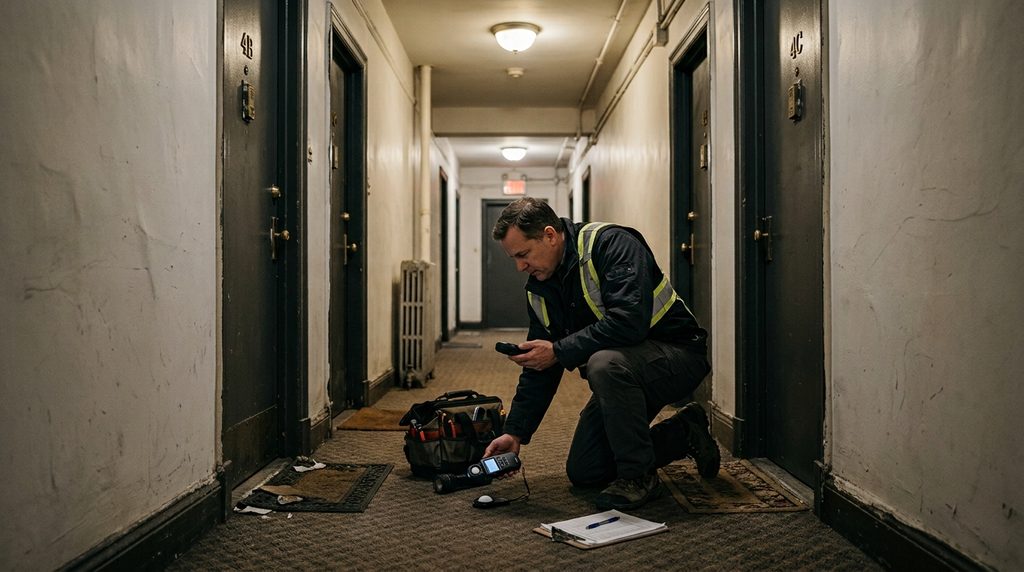
A broken fixture may be replaced shortly after an injury, and the original lighting conditions may disappear.
| Evidence | Why It Matters |
| Accident scene photographs | Documents the location and surrounding conditions |
| Nighttime photographs | May help illustrate visibility under comparable circumstances |
| Lighting measurements | May establish whether applicable illumination standards were satisfied |
| Maintenance requests | May demonstrate earlier complaints about lighting defects |
| Repair and inspection records | Helps establish maintenance history and notice |
| Surveillance footage | May show the accident and operating lighting conditions |
| Witness statements | May confirm how the area appeared before the accident |
| Building inspection reports | May identify relevant safety requirements or violations |
| Electrical maintenance documents | May show recurring lighting failures |
| Medical records | Documents the injuries and treatment |
| Financial records | Supports claims for economic losses |
Accident Scene Photographs
Photographs should document the location where the injury occurred.
Useful images may show broken light fixtures, dark stairways, uneven floors, obstructions, and nearby sources of illumination.
Photographs should ideally reflect conditions comparable to those that existed when the accident happened.
Nighttime Photographs
Nighttime photographs can be especially relevant when an injury occurred after dark.
However, camera settings and automatic exposure adjustment can make an area appear brighter than it was.
Photographs should therefore be evaluated alongside witness accounts, measurements, and other evidence.
Professional Lighting Measurements
Qualified professionals may measure illumination using a light meter.
A foot-candle measurement may help determine whether an applicable statutory standard was satisfied.
For example, measurements at floor level may be relevant when assessing lighting in a covered New York City residential hallway.
Measurements obtained after repairs may not accurately represent the original conditions.
Maintenance Complaints and Repair Records
Written complaints may establish that a property owner or management company knew about defective lighting.
Potentially relevant documents include:
- Tenant emails
- Maintenance portal requests
- Text messages
- Electrical work orders
- Inspection logs
- Records of replacement fixtures
- Previous incident reports
The timing and specificity of these records matter.
Surveillance Footage
Security cameras may show the accident or whether particular light fixtures were operating.
Recordings may be overwritten after a limited period, making early identification important.
Witness Statements
Residents, visitors, employees, or other people familiar with the property may describe whether the area was unusually dark.
Witnesses may also know whether the lighting problem existed before the accident.
What Should Someone Do After an Accident Caused by Poor Lighting?
The immediate priority is safety and medical attention.
Once urgent needs are addressed, several steps may help preserve relevant evidence.
1. Seek Medical Attention
Obtain emergency care when serious injuries are suspected.
Falls may cause fractures, head injuries, spinal injuries, or other medical complications.
2. Report the Accident
Notify the landlord, property manager, business operator, or appropriate representative.
Describe the accident location and known circumstances accurately.
3. Document the Lighting Conditions
Photograph the relevant fixtures, staircase, hallway, or walkway when it is safe.
If possible, document whether lights were off, flickering, or otherwise malfunctioning.
4. Identify Other Hazards
Record any broken steps, loose carpeting, uneven pavement, or obstructions that may have contributed to the accident.
5. Collect Witness Information
Obtain contact information from people who observed the fall or knew about the lighting problem.
6. Preserve Maintenance Complaints
Save emails, texts, work orders, and other communications documenting earlier lighting issues.
7. Identify Surveillance Cameras
Determine whether nearby security cameras may have recorded the accident or the lighting conditions.
8. Keep Medical and Financial Records
Maintain medical bills, treatment summaries, prescription receipts, transportation expenses, and documentation of missed work.
9. Review Applicable Filing Deadlines
Determine who owned or controlled the property.
Claims against private property owners and public entities may involve different procedures.
What Injuries Can Result From Inadequate Lighting Accidents?
Inadequate lighting accidents may cause injuries ranging from temporary soft tissue damage to permanent disability.
The type and severity depend on the mechanism of the fall, the surface involved, and other circumstances.
Head and Traumatic Brain Injuries
A person may strike their head against a staircase, wall, floor, or other structure.
Possible consequences include concussion, dizziness, headaches, cognitive difficulties, and more serious neurological problems.
Hip and Pelvic Fractures
Falls on hard surfaces may cause hip or pelvic injuries.
Older adults may face substantial recovery challenges, including surgery and extended rehabilitation.
Wrist and Arm Fractures
A person who extends an arm to stop a fall may suffer a wrist fracture, elbow injury, or shoulder damage.
Back and Spinal Injuries
Trips and falls may cause spinal fractures, disc injuries, nerve damage, or other back conditions.
Serious injuries can affect mobility and the ability to work.
Knee and Ankle Injuries
Unexpected changes in elevation may cause twisting injuries.
Ligament tears, joint injuries, and fractures may require physical therapy or surgery.
Long-Term Functional Limitations
Some injuries result in chronic pain, reduced independence, or continuing medical care.
These consequences may become relevant to compensation when properly documented.
Does Property Liability Insurance Cover Inadequate Lighting Injuries?
Many landlords and commercial property owners maintain liability insurance that may respond to covered premises liability claims.
However, the existence of insurance does not automatically establish negligence or guarantee compensation.
What Does the Insurance Company Investigate?
An insurer may review:
- Whether the lighting was inadequate
- Whether an applicable legal duty existed
- Whether the insured controlled the location
- Whether the insured created or had notice of the hazard
- Whether inadequate illumination contributed to the accident
- Whether the injured person shared responsibility
- Medical documentation and financial losses
- The terms and limits of the insurance policy
Are Medical Bills Automatically Covered?
Not necessarily.
Property liability insurance differs from automobile no-fault insurance.
Certain policies may offer limited medical payments coverage, but broader compensation generally depends on an applicable legal and insurance basis.
Health insurance may be relevant to immediate treatment expenses.
Can a Claim Settle Without Litigation?
Yes.
Some premises liability claims resolve through insurance negotiations.
The outcome depends on the evidence of negligence, injury severity, comparative fault, damages, and available coverage.
A final settlement may involve releasing future claims related to the accident.
Can Comparative Negligence Reduce Compensation?
Yes.
New York generally applies comparative negligence principles to ordinary premises liability claims.
Under CPLR § 1411(a), an injured person’s own negligence generally reduces recoverable damages according to that person’s percentage of responsibility.
For example, a property owner may fail to maintain safe lighting while the injured person’s conduct also contributes to the accident.
The legal analysis must consider both parties’ conduct.
How Does Shared Fault Affect Damages?
Consider the following hypothetical example:
| Factor | Illustrative Amount |
| Total Legally Established Damages | $100,000 |
| Injured Person’s Share of Fault | 20% |
| Comparative Negligence Reduction | $20,000 |
| Remaining Damages | $80,000 |
This example illustrates proportional reduction only and does not predict a settlement.
Actual recovery depends on the applicable law, evidence, and other case-specific circumstances.
Does Entering a Dark Area Make Someone Negligent?
Not automatically.
A tenant, visitor, or customer may have a legitimate reason to use a dimly illuminated hallway, staircase, or parking area.
Whether the person acted reasonably depends on visibility, familiarity with the premises, available alternatives, and other circumstances.
What If the Hazard Was Open and Obvious?
A condition’s visibility may be relevant to comparative fault.
However, the fact that a hazard was visible does not necessarily eliminate a property owner’s duty to maintain reasonably safe premises.
Moreover, a hazard that is apparent in daylight may be difficult to recognize when lighting is inadequate.
Do the 2026 Comparative Negligence Changes Apply?
New York amended CPLR § 1411 in 2026 to establish an additional fault restriction for certain personal injury actions governed by Insurance Law Article 51.
That provision generally concerns qualifying motor vehicle injury claims.
It ordinarily does not apply to a conventional premises liability lawsuit involving inadequate lighting.
The usual proportional comparative negligence rule therefore remains relevant to most such claims.
What Compensation May Be Available After an Inadequate Lighting Injury?
Potential compensation depends on the injuries, legally responsible parties, financial losses, and supporting evidence.
Medical Expenses
Recoverable expenses may include emergency treatment, hospitalization, surgery, diagnostic imaging, medications, rehabilitation, and continuing medical care.
Future treatment expenses may also be relevant when supported by appropriate evidence.
Lost Income
An injured person may be unable to work during recovery.
Documented lost earnings may include missed wages, reduced hours, or other qualifying income losses.
Reduced Earning Capacity
A permanent injury may affect the ability to return to previous employment.
Future earning losses require suitable medical and financial evidence.
Pain and Suffering
Qualifying negligence claims may allow compensation for physical pain, emotional distress, and reduced enjoyment of normal activities.
The amount depends on the severity, duration, and consequences of the injuries.
Long-Term Rehabilitation and Care
Serious injuries may require continuing therapy, mobility equipment, home modifications, or personal assistance.
These expenses may be considered when legally recoverable and supported by evidence.
Wrongful Death Damages
When negligent property conditions contribute to a fatal injury, a personal representative may have grounds to pursue a wrongful death claim.
Separate statutory requirements, deadlines, and damages rules apply.
How Long Does Someone Have to File an Inadequate Lighting Injury Claim in New York?
Under CPLR § 214(5), most ordinary negligence-based personal injury lawsuits in New York must be commenced within three years.
However, different rules may apply depending on the defendant and nature of the claim.
| Claim Type | General Filing Requirement |
| Ordinary Personal Injury Claim Against a Private Property Owner | Generally three years |
| Certain Municipal Injury Claims | Notice of claim generally required within 90 days |
| Covered Municipal Negligence Lawsuit | Generally one year and 90 days |
| Certain Claims Against New York State | Special Court of Claims procedures and shorter initial deadlines |
| Wrongful Death Claim | Generally two years, subject to applicable exceptions |
The New York State Senate’s CPLR § 214 establishes the general three-year filing period for personal injury actions.
What If the Accident Happened on Government Property?
Accidents involving government-operated buildings, public parking facilities, or other publicly controlled locations may trigger specialized procedural requirements.
Under General Municipal Law § 50-e, certain municipal tort claims require a notice of claim within 90 days.
General Municipal Law § 50-i generally establishes a one-year-and-90-day commencement period for covered municipal negligence actions.
Claims against New York State follow separate Court of Claims Act procedures.
What If the Injured Person Is a Minor?
Certain limitations-period rules may be affected by the injured person’s age.
However, different statutory notice requirements may still apply.
The relevant deadlines depend on the circumstances and responsible defendant.
Why Is Early Evidence Preservation Important?
Lighting conditions may change shortly after an accident.
A burned-out fixture may be replaced, additional lights installed, or electrical problems repaired.
Surveillance recordings may also be overwritten, and witnesses may become difficult to locate.
Preserving evidence promptly can help establish the original conditions.
What Mistakes Can Weaken an Inadequate Lighting Injury Claim?
Several common mistakes may make it harder to establish negligence, causation, or damages.
These include:
- Failing to photograph the accident location
- Taking only daytime photographs after a nighttime accident
- Not documenting which light fixtures were defective
- Overlooking nearby stairway or flooring hazards
- Discarding earlier maintenance complaints
- Failing to collect witness information
- Allowing relevant surveillance footage to be overwritten
- Waiting until after lighting repairs to document the condition
- Delaying necessary medical evaluation
- Assuming that any dark area automatically establishes negligence
- Assuming a building code violation guarantees compensation
- Failing to identify the correct property owner or management company
- Accepting a settlement before understanding long-term injuries
- Missing applicable notice or lawsuit filing deadlines
A well-supported claim generally requires evidence of the relevant legal duty, the unsafe condition, notice where required, causation, and documented damages.
When May Legal Guidance Be Useful?
Legal guidance may be particularly valuable when inadequate lighting causes serious injuries, substantial medical expenses, or long-term functional limitations.
Additional investigation may be necessary when a property owner disputes the lighting conditions, argues that the area was adequately illuminated, or claims that another factor caused the accident.
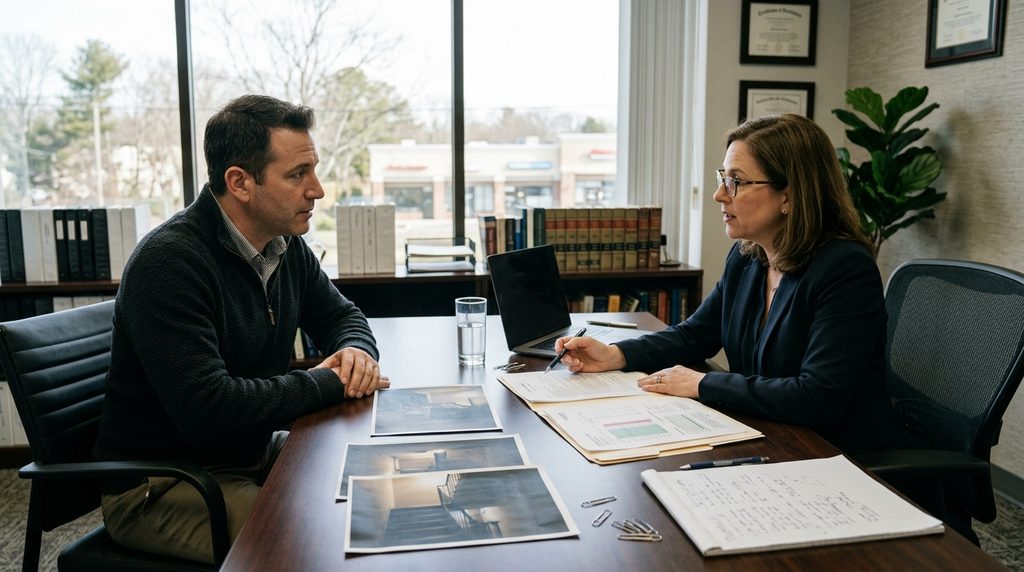
Complex cases may involve statutory lighting measurements, building code analysis, separate property owners, maintenance contractors, or government-controlled facilities.
People researching local legal services may review a Farmingdale legal office location when seeking information about inadequate lighting injury claims on Long Island.
Every claim depends on its circumstances, and the existence of poor lighting does not guarantee compensation.
Frequently Asked Questions About Inadequate Lighting Injury Claims
Can someone sue a landlord for injuries caused by poor hallway lighting?
Yes. A tenant or visitor may pursue a claim when a landlord negligently fails to maintain reasonably safe hallway lighting and that failure causes an injury. Relevant evidence may include photographs, maintenance complaints, applicable lighting requirements, witness testimony, and medical records. Liability depends on the landlord’s legal duties, notice where required, and the accident circumstances.
What if a broken stairwell light caused someone to fall?
A broken stairwell light may support a personal injury claim when the responsible party breached an applicable duty and the lighting defect contributed to the fall. The investigation may consider how long the light was defective, whether management knew about it, and whether applicable residential lighting requirements were violated.
How can someone prove that a property was inadequately illuminated?
Evidence may include nighttime photographs, witness statements, maintenance records, surveillance footage, and professional light meter measurements. Applicable building regulations may establish minimum illumination requirements. However, photographs and measurements taken after repairs may not accurately reflect the conditions that existed when the accident occurred.
Can someone file a claim if poor lighting contributed to a fall over another hazard?
Potentially, yes. Inadequate lighting does not have to be the sole cause of an accident. A claim may involve poor illumination combined with a defective step, uneven walkway, or obstruction. The evidence must establish that the defendant breached a legal duty and that the negligent condition contributed to the injury.
How long does someone have to file an inadequate lighting injury lawsuit in New York?
Most ordinary negligence-based personal injury lawsuits against private property owners must be filed within three years. However, certain claims involving municipalities or other government entities have shorter notice and filing requirements. The responsible party and applicable procedural rules should be identified promptly to avoid missing deadlines.
Conclusion
Inadequate lighting injury claims in New York require careful investigation because a dark stairway, hallway, parking garage, or pedestrian walkway does not automatically establish negligence. The central issues involve the responsible party’s duty of care, the adequacy of the lighting, notice of the condition where required, and whether the hazard caused the injuries.
New York’s residential lighting regulations and recent appellate decisions demonstrate why illumination at the actual accident location matters. Poor lighting may also contribute to an accident alongside defective stairs, uneven pavement, or other dangerous conditions.
Photographs, maintenance records, lighting measurements, surveillance footage, witness statements, and medical documentation can help establish what happened and which parties may be legally responsible.
Understanding premises liability principles, comparative negligence, available compensation, and filing deadlines can help injured people evaluate potential claims using reliable evidence.
Image Suggestions
All images should use photorealistic premium editorial photography, authentic New York property or professional environments, natural human proportions, and a wide horizontal 16:9 aspect ratio. Do not include brand names, logos, readable text, watermarks, blood, or graphic injuries.
| Image Type | Placement | Suggested Visual | ALT Text | Image Generation Prompt (16:9) |
| Featured Image | Below H1 | Dim apartment building staircase with malfunctioning lighting and visible shadows | Inadequate stairway lighting creating a potential injury hazard in a New York apartment building | Create a photorealistic premium editorial property-safety photograph showing an interior staircase in a realistic New York apartment building with poor artificial lighting. One overhead ceiling fixture is visibly malfunctioning, leaving deep but natural shadows across several stair treads and a landing. An adult resident in ordinary casual clothing approaches the staircase cautiously without falling. Include authentic multifamily residential architecture, realistic stair construction, worn but believable surfaces, natural human proportions, and accurately rendered low-light conditions. Emphasize the visibility problem and difficulty identifying step edges. Professional documentary-style commercial photography, sophisticated composition, wide horizontal 16:9 aspect ratio. No brand names, logos, readable text, injuries, blood, or watermarks. |
| Supporting Image 1 | Under “Where Do Inadequate Lighting Accidents Commonly Occur?” | Poorly illuminated parking garage pedestrian walkway with uneven concrete pavement | Dark parking garage walkway with inadequate lighting and uneven pavement | Create a photorealistic premium editorial infrastructure-safety photograph of a modern American parking garage with insufficient overhead lighting along a pedestrian walkway. Show a subtle but visible uneven concrete surface, a raised pavement edge, several generic parked passenger vehicles, and realistic structural columns. Emphasize the contrast between illuminated and shadowed areas while maintaining believable exposure. Include detailed concrete textures, natural perspective, authentic parking garage architecture, and professional low-light photography. Wide horizontal 16:9 composition. No people, brand names, logos, readable text, injuries, or watermarks. |
| Supporting Image 2 | Under “What Evidence Is Important in an Inadequate Lighting Injury Claim?” | Professional building inspector measuring floor-level illumination with a digital light meter | Building inspector measuring inadequate hallway lighting with a professional light meter | Create a photorealistic high-detail editorial property-inspection photograph showing an adult building safety inspector measuring illumination near floor level inside a dimly lit New York residential hallway. The inspector holds a generic digital light meter close to the walking surface, with a clipboard and professional inspection equipment nearby. Include realistic hallway light fixtures, residential doors, subtle shadows, authentic construction materials, and correct light-measurement positioning. Emphasize professional lighting assessment, natural human proportions, detailed equipment, and balanced low-light photography. Premium commercial documentary style, wide horizontal 16:9 aspect ratio. No brand names, logos, readable display text, or watermarks. |
| Supporting Image 3 | Under “When May Legal Guidance Be Useful?” | Injured adult reviewing poor-lighting accident photographs and maintenance records with a legal professional | Inadequate lighting injury consultation reviewing accident and maintenance evidence | Create a photorealistic premium editorial photograph showing an adult injury claimant in casual professional clothing meeting with a legal professional inside a contemporary Long Island office. Both adults are seated across a desk, naturally reviewing printed photographs of a poorly illuminated apartment staircase, generic building maintenance complaints, medical documentation, and organized accident records. Emphasize attentive natural facial expressions, realistic human anatomy, authentic office furnishings, soft balanced daylight, and a professional consultation environment. Sophisticated legal editorial commercial photography, wide horizontal 16:9 composition. No brand names, logos, readable text, blood, injuries, or watermarks. |
