

Finding an injury clinic after a car accident can feel surprisingly complicated.
A quick search may produce dozens of options.
Some clinics emphasize chiropractic care. Others focus on rehabilitation. Some offer several types of treatment. Others specialize in particular injuries or patient populations.
So how do you compare them?
The answer shouldn’t be based on whichever clinic has the most impressive advertisement or the closest location.
Instead, look at the quality of the evaluation, relevance of the services, communication, safety, rehabilitation approach, and practical convenience.
If you’re searching for an accident injury clinic in the Farmers Branch area, the following checklist can help you make a more informed comparison.
Start With the Reason You’re Seeking Care
Before comparing clinics, identify what you actually need help with.
After a collision, common concerns can include:
- Neck pain
- Back discomfort
- Muscle soreness
- Headaches
- Reduced range of motion
- Shoulder discomfort
- Numbness or tingling
- Difficulty driving
- Difficulty working
- Trouble sleeping
- Reduced ability to exercise
Whiplash is one example of an injury that can produce symptoms that aren’t necessarily obvious immediately after a collision.
Mayo Clinic notes that whiplash symptoms may include neck pain and stiffness, reduced range of motion, headaches, shoulder or upper-back pain, arm tingling or numbness, fatigue, and dizziness. Symptoms often begin within days of the injury.
Understanding your symptoms gives you a better starting point for evaluating whether a particular clinic is relevant to your situation.
What Makes One Injury Clinic Different From Another?
Two clinics may both advertise accident care while taking very different approaches.
When comparing them, consider these questions:
Does the clinic perform an actual evaluation?
Does it regularly handle accident-related injuries?
Does it consider how your injury affects everyday activities?
Does it offer rehabilitation when appropriate?
Does the provider explain the recommended treatment?
Does the clinic monitor progress?
Does it recognize when another level of medical care may be necessary?
These questions are more useful than simply comparing slogans or promotional claims.
1. Look at the Initial Evaluation
A good comparison starts with what happens before treatment.
An evaluation may consider:
- How the accident occurred
- When symptoms began
- Where symptoms are located
- Range of motion
- Tenderness
- Strength
- Sensation
- Reflexes
- Functional limitations
For example, if you have neck pain after a collision, an evaluation may look at how far you can rotate your neck, whether movement increases pain, and whether there are changes in strength or sensation.
Mayo Clinic’s guidance on whiplash describes an evaluation that can include checking range of motion, tenderness, reflexes, strength, and sensation.
That is very different from simply asking where you hurt and immediately starting a predetermined treatment routine.
2. Compare the Clinic’s Experience With Accident-Related Conditions
Experience matters because accident injuries can present differently from routine aches and pains.
A clinic that regularly works with post-collision patients may be familiar with concerns such as:
- Whiplash
- Neck stiffness
- Back pain
- Soft-tissue discomfort
- Reduced mobility
- Headaches associated with musculoskeletal problems
- Functional limitations after an accident
That doesn’t mean experience alone guarantees a particular outcome.
It means the provider may be more familiar with the types of questions and functional issues that commonly arise after a collision.
When speaking with a clinic, ask directly:
How frequently do you work with patients after auto accidents?
What types of accident-related injuries do you typically evaluate?
How do you determine whether chiropractic care is appropriate?
Those questions can tell you more than a generic claim about being an “accident clinic.”
3. Look Beyond the Word “Chiropractic”
Chiropractic care can involve different approaches.
The National Center for Complementary and Integrative Health explains that spinal manipulation uses a controlled thrust applied to a spinal joint, while spinal mobilization involves movement within a joint’s natural range without a thrust.
NCCIH also notes that spinal manipulation is one of several nondrug approaches that may be used for low-back pain and can produce modest improvements in pain and function for some patients.
The important point is that you shouldn’t compare clinics solely by asking:
“Do they provide adjustments?”
Instead, ask:
“What does the overall care plan involve?”
That may include mobility-focused treatment, exercise, rehabilitation, education, or other appropriate services.
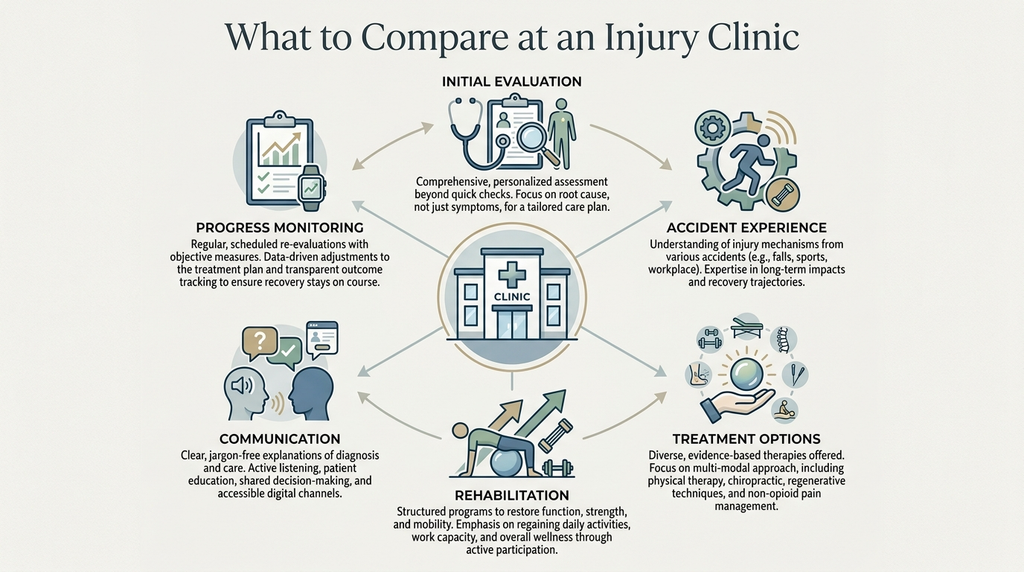
4. Ask About Rehabilitation
Recovery after an accident may involve more than passive treatment.
Depending on the injury, rehabilitation can involve:
- Range-of-motion work
- Strengthening
- Posture
- Coordination
- Endurance
- Functional movement
- Gradual return to activity
Mayo Clinic notes that physical therapy for ongoing whiplash symptoms may help restore movement, strengthen muscles, improve posture, and support a return to regular activities.
So when comparing clinics, ask whether rehabilitation is available when appropriate.
You don’t necessarily need a clinic that offers every possible service.
You do want to understand whether the available approach matches your needs.
5. Find Out How Progress Is Monitored
A treatment plan should include a way to determine whether things are changing.
Ask how the clinic evaluates progress.
For example:
- Is your range of motion reassessed?
- Are functional limitations discussed?
- Are symptoms tracked?
- Are exercises adjusted as your abilities change?
- Does the provider modify the plan if you’re not progressing as expected?
Progress isn’t necessarily measured by pain alone.
You might still have some discomfort while driving, working, sleeping, and moving, but much more comfortably.
Those functional improvements matter.
6. Pay Attention to Communication
Good communication should start before treatment begins.
A clinic should be willing to explain:
- What the evaluation involves
- What the provider believes may be contributing to symptoms
- Why a treatment is being recommended
- What you should expect
- What activities may need modification
- When you should follow up
- What symptoms require additional medical attention
You should feel comfortable asking questions.
You should also understand that an evaluation may reveal that chiropractic care isn’t the appropriate first option.
That is part of responsible care.
Safety Should Be Part of the Comparison
A clinic should not simply assume that every accident-related complaint is suitable for routine chiropractic treatment.
NCCIH reports that spinal manipulation can produce temporary side effects such as soreness, stiffness, headache, or increased discomfort. Serious adverse events are very rare, but the agency emphasizes the importance of considering health conditions and medications before treatment.
That means a provider should want to know about relevant medical history.
Before treatment, be prepared to discuss:
- Previous injuries
- Existing medical conditions
- Medications
- Recent trauma
- Neurological symptoms
- Changes in strength or sensation
A clinic that asks these questions demonstrates that treatment should be based on the individual rather than on a standard routine.
Know When an Injury Clinic Isn’t the Right First Stop
Comparing injury clinics is only useful after emergency concerns have been addressed.
Certain symptoms after a collision require urgent medical attention.
These can include:
- Worsening headache
- Repeated vomiting
- Increasing confusion
- Difficulty waking
- Seizures
- Loss of consciousness
- Slurred speech
- Significant weakness
- Numbness
- Major coordination problems
These are among the danger signs identified by the CDC following possible traumatic brain injury.
If serious neurological or traumatic symptoms are present, emergency medical care should take priority over a routine chiropractic appointment.
Likewise, severe neck or back trauma accompanied by significant neurological symptoms requires appropriate medical evaluation.
The best injury clinic is not the one that tries to treat every situation.
It’s the one that understands when a patient needs a different level of care.
Location and Convenience Matter Too
Healthcare quality should be the primary consideration, but practical factors still matter.
If your recovery requires follow-up visits, consider:
- Distance from home
- Distance from work
- Parking
- Appointment availability
- Hours
- Transportation
- Convenience for future visits
A clinic that is easy to reach can make it simpler to maintain appointments.
For patients in and around Farmers Branch, you can learn more about Premier Injury Clinics of DFW’s Farmers Branch injury chiropractic services when comparing local options.

How to Compare Treatment Plans
Don’t compare plans simply by counting the number of treatments offered.
Instead, ask what each treatment is intended to accomplish.
For example:
Mobility treatment may focus on appropriate movement restrictions.
Exercise may address strength, endurance, or movement control.
Rehabilitation may focus on returning to functional activities.
Education may help you understand activity modification and recovery.
The question should be:
“Why is this treatment being recommended for me?”
A clear answer can help you understand whether the plan makes sense for your condition.
Beware of Guaranteed Recovery Claims
Be cautious of any clinic that promises a specific outcome or recovery timeline before properly evaluating you.
Accident injuries vary.
Two people involved in similar collisions can have very different symptoms, medical histories, and recovery patterns.
A responsible provider should be willing to say:
“We need to evaluate you first.”
Rather than promising a particular result before knowing what is wrong.
The same principle applies to treatment duration.
Ask how the provider determines when care should continue, change, or stop.
What Should You Bring to an Injury Clinic?
You don’t need to diagnose yourself before your appointment.
But useful information can make your evaluation more productive.
Consider bringing or knowing:
- Date of the accident
- Basic description of how the collision occurred
- When symptoms first appeared
- Current symptoms
- Changes in symptoms
- Previous injuries
- Current medications
- Relevant medical conditions
- Any previous treatment
- Activities that have become difficult
Also describe functional changes.
Instead of saying:
“My back hurts.”
Explain:
“My back becomes uncomfortable after sitting for 45 minutes.”
That gives the provider a clearer picture of how the problem affects your daily life.
Questions to Ask Before Choosing an Accident Injury Clinic
If you’re comparing several clinics, ask each one similar questions.
About Evaluation
What does the initial evaluation include?
How do you assess movement and function?
About Experience
How often do you work with patients after car accidents?
What accident-related conditions do you commonly see?
About Treatment
What types of treatment may be appropriate for my condition?
Do you offer rehabilitation or exercise-based care when appropriate?
About Progress
How do you monitor whether I’m improving?
How is the treatment plan adjusted if my symptoms change?
About Safety
What symptoms would require additional medical evaluation?
About Practical Matters
What are your appointment hours?
Where are you located?
What should I bring to my first appointment?
The answers can help you compare clinics on substance rather than appearance.
A Simple Injury Clinic Comparison Checklist
You can use this checklist when researching providers:
| Factor | What to Look For |
| Evaluation | A meaningful assessment before treatment |
| Accident Experience | Familiarity with post-collision injuries |
| Treatment Options | Care appropriate to the individual’s condition |
| Rehabilitation | Exercise or functional recovery when appropriate |
| Communication | Clear explanations and opportunity to ask questions |
| Progress | Ongoing assessment of symptoms and function |
| Safety | Recognition of warning signs and contraindications |
| Convenience | Location, hours, parking, and appointment availability |
The goal isn’t to find a clinic that scores perfectly in every category.
It’s about finding one that appears appropriate for your situation and clearly communicates what it can and cannot provide.
Comparing an Accident Injury Clinic in Farmers Branch
For someone researching an accident injury clinic in the Farmers Branch area, Premier Injury Clinics of DFW is one local option to consider.
Its Farmers Branch location provides chiropractic and rehabilitation-focused services for accident-related and musculoskeletal concerns.
Before making a decision, review the clinic’s services and consider whether its approach matches your symptoms and recovery needs.
You can explore the Farmers Branch injury chiropractic services to learn more.
Frequently Asked Questions
How do I choose an accident injury clinic after a car accident?
Start by looking at the clinic’s evaluation process, experience with accident-related injuries, treatment options, rehabilitation services, communication, safety practices, and convenience. The best choice depends on your individual symptoms and needs.
Should I choose a clinic based on how close it is?
Location is useful, particularly if follow-up appointments are needed, but it shouldn’t be the only factor. Consider the quality of evaluation, relevant experience, treatment approach, communication, and rehabilitation options as well.
What should an injury clinic evaluate after a car accident?
Depending on your symptoms, an evaluation may consider how the accident occurred, when symptoms began, range of motion, tenderness, strength, sensation, reflexes, and how the injury affects everyday activities.
Does every car accident require chiropractic care?
No. Some people may require emergency medical care, while others may benefit from conservative treatment, rehabilitation, or other medical services. Chiropractic care should be considered based on an appropriate evaluation.
Can chiropractic care be part of accident rehabilitation?
It can be appropriate for certain patients. Chiropractic treatment may be combined with exercise or rehabilitation, depending on the individual’s condition and goals. Mayo Clinic notes that physical therapy and exercise can help restore movement after whiplash.
What should I ask an accident injury clinic before treatment?
Ask about the initial evaluation, experience with accident injuries, treatment options, rehabilitation, progress monitoring, safety considerations, appointment process, and what symptoms would require additional medical evaluation.
When should I seek emergency care instead of visiting an injury clinic?
Serious symptoms such as worsening headache, repeated vomiting, confusion, difficulty waking, seizures, loss of consciousness, significant weakness, or numbness require urgent medical attention rather than waiting for a routine injury-clinic appointment.
Final Takeaway
Choosing an injury clinic after a car accident shouldn’t come down to whichever listing appears first in a search result.
Look at the evaluation, experience, treatment approach, rehabilitation options, communication, safety, progress monitoring, and practical convenience.
A good clinic should be interested in understanding your individual situation rather than assuming every accident injury can be handled the same way.
For Farmers Branch residents researching an accident injury clinic, Premier Injury Clinics of DFW is one local resource you can evaluate based on these criteria.
The right decision is ultimately the one that matches your medical needs, symptoms, and recovery goals.
Don’t compare clinics by promises. Compare them by how thoughtfully they evaluate your injury, explain your options, and support appropriate recovery.
