

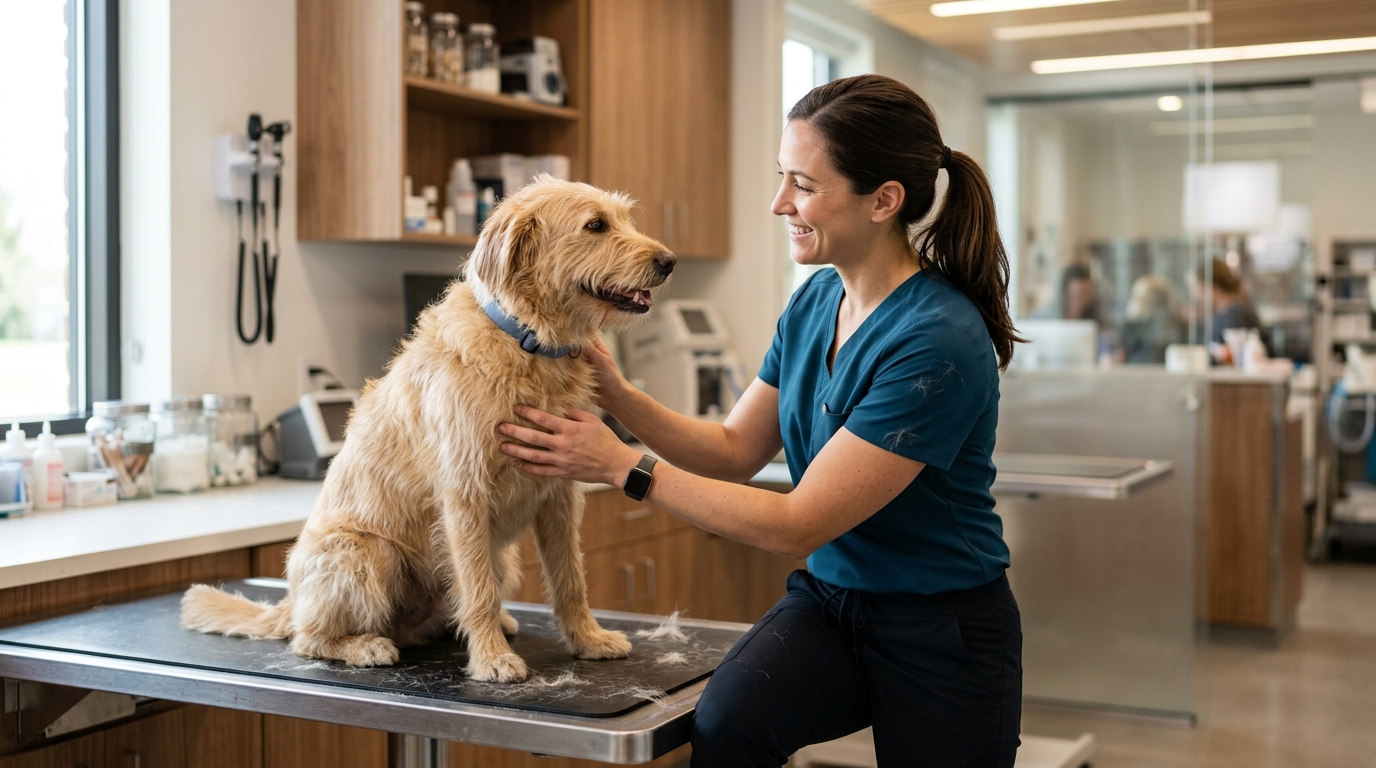
Veterinary professionals need scrubs that can handle more than routine clinical movement. Daily work may involve close contact with dogs, cats, and other animals, which means fur, hair, dander, lint, and environmental debris can quickly become noticeable on work clothing. Fabric surface, weave, stretch, weight, drape, and ease of cleaning can all affect how practical a scrub set feels in an animal-care setting.
Performance-focused options such as the Epic scrub collection emphasize smoother performance fabric, lightweight wear, mobility, and easier removal of lint and dog hair. The broader goal, however, is to choose scrubs that balance hair release, comfort, movement, professional appearance, and realistic garment care rather than relying on one fabric claim alone. (IRG Scrubs)
Quick Answer
Veterinary professionals dealing with pet hair and lint should generally look for scrub fabrics with:
- A smooth surface: Hair and lint tend to be easier to brush away from smoother materials than from fuzzy or heavily textured fabrics.
- A relatively tight surface structure: This can reduce how deeply loose hair works into the textile.
- Useful stretch: Veterinary work frequently requires bending, crouching, reaching, lifting, and quick position changes.
- Good recovery: Stretch fabric should return toward its original shape after repeated movement.
- Lightweight construction: Less fabric bulk can improve comfort during active work.
- Practical care requirements: Scrubs should fit into a frequent workwear laundry routine.
- Secure pockets: Veterinary professionals often need storage without creating excessive garment drag or bulk.
No scrub fabric is completely immune to animal hair. The practical goal is to choose material that makes hair and lint easier to remove while still supporting the physical demands of veterinary work.
Why is pet hair such an important scrub-fabric consideration?
Veterinary medicine places workers in unusually close contact with animals compared with many other healthcare settings.
Veterinary and animal-care workers can encounter animal hair, fur, saliva, urine, and dander during their normal duties. NIOSH identifies animal proteins from hair and fur, along with saliva, urine, and dander, as occupational allergens relevant to veterinary and animal-care workers. (CDC)
This makes the clothing environment different from a conventional office or many human clinical settings.
A veterinary worker may:
- Hold or restrain a shedding dog.
- Carry a cat against the scrub top.
- Kneel beside an animal.
- Lean against an examination table.
- Handle blankets or bedding.
- Move between treatment and kennel areas.
- Encounter loose fur throughout the workplace.
The result is that workwear can collect visible hair throughout a shift.
The issue is partly cosmetic, but practicality also matters. A scrub set that holds hair stubbornly may require repeated use of a lint roller or additional garment maintenance before or after work.
What fabric surface is best for reducing pet hair buildup?
Surface texture is one of the most important characteristics to evaluate.
In general, a smoother textile gives loose hair fewer obvious surface irregularities in which to become mechanically caught.

Smooth performance fabrics
Smooth scrub fabrics can be particularly practical for veterinary professionals.
They may allow loose hair or lint to sit closer to the surface rather than becoming deeply embedded.
This can make it easier to:
- Brush away visible hair.
- Use a lint roller quickly.
- Shake loose debris from the garment.
- Maintain a cleaner-looking uniform during the day.
Performance scrub fabrics are therefore often attractive to veterinary teams that regularly work around shedding animals.
Fuzzy or highly textured fabrics
Textured surfaces may provide more opportunities for hair and lint to become caught.
The amount of buildup can vary according to:
- Fiber construction
- Surface texture
- Static
- Animal coat type
- Environmental conditions
A soft fabric is not necessarily a poor choice, but veterinary professionals who regularly struggle with hair-covered uniforms may want to compare surface texture carefully.
Does weave or textile structure matter?
Yes.
The way fibers and yarns are constructed into a textile can affect the surface of the finished garment.
A compact, relatively smooth performance material may behave differently from a fabric with a more open, fuzzy, or brushed surface.
Veterinary professionals do not need to become textile engineers to evaluate this.
A simple in-person inspection can help.
Examine the surface closely
Look at the fabric under normal lighting.
Ask:
- Does it look smooth?
- Can individual fuzzy fibers be seen on the surface?
- Does the fabric feel sleek or brushed?
- Does lint already appear on the display garment?
Run a hand across the fabric
The goal is not to judge quality based purely on softness.
Instead, notice whether the material has:
- A smooth finish
- A noticeable nap
- Raised fibers
- A very textured surface
For pet-hair management, a smoother surface is often easier to maintain.
Why does static affect animal hair on scrubs?
Static can influence how easily lightweight materials such as pet hair and lint cling to clothing.
The amount of static can vary according to:
- Fabric composition
- Indoor humidity
- Drying conditions
- Other garments
- Environmental conditions
This means even a smooth fabric can occasionally attract hair.
No scrub should therefore be marketed or understood as completely pet-hair proof.
Look for practical hair release rather than absolute repellency
A more useful question is:
How easily can hair be removed from the garment?
The difference between a practical veterinary scrub fabric and a frustrating one may be whether loose fur:
- Brushes off quickly
- Requires repeated lint rolling
- Becomes embedded in the textile
- Remains obvious after normal handling
The existing performance positioning for Epic specifically notes that smoother fabrics can make lint and dog hair easier to remove and describes hair as less likely to become stubbornly embedded. (IRG Scrubs)
What scrub fibers should veterinary professionals consider?
Modern medical workwear often uses blended fabrics rather than a single fiber.
Common materials can include:
- Polyester
- Recycled polyester
- Rayon
- Spandex
- Cotton
Each contributes different characteristics depending on how the textile is engineered.
Polyester-based performance fabrics
Polyester is commonly used in performance workwear.
Depending on the construction, polyester-based fabric may provide:
- A smooth surface
- Lightweight construction
- Shape stability
- Practical garment care
- Compatibility with stretch fibers
The surface characteristic is especially relevant for veterinary professionals.
A smooth polyester-based performance textile may make loose hair easier to remove than a more textured material.
However, not every polyester fabric is identical.
The full textile construction matters.
Recycled polyester
Some modern scrub fabrics incorporate recycled polyester.
Recycled content and performance should be evaluated as separate garment considerations.
A veterinary professional should still ask:
- How smooth is the surface?
- Does the fabric stretch?
- Is the material lightweight?
- How does it drape?
- What are the care instructions?
The fact that a garment contains recycled polyester does not automatically explain how easily animal hair will release.
Spandex and mobility
Spandex is frequently included in smaller percentages to contribute elasticity.
That can be especially useful in veterinary medicine because work may involve repeated lower- and upper-body movement.
Stretch can support:
- Crouching
- Reaching
- Squatting
- Bending
- Sitting on low stools
- Moving quickly around an examination room
The most practical veterinary scrubs often combine hair-management characteristics with enough flexibility for active work.
Why does stretch matter so much in veterinary work?
Veterinary medicine can involve positions that are less predictable than traditional standing clinical work.

An animal does not always remain at a convenient working height.
Veterinary professionals may need to:
- Kneel beside a large dog.
- Lean across an examination table.
- Crouch to assess an animal.
- Reach during restraint.
- Move quickly when an animal shifts position.
This places repeated tension on different areas of the garment.
Scrub tops need upper-body flexibility
A veterinary scrub top should allow movement through:
- Shoulders
- Upper back
- Chest
- Sleeves
- Torso
Test a top by reaching forward and upward.
Cross the arms.
Rotate the torso.
The garment should not create severe resistance across the back.
Scrub pants need lower-body mobility
Veterinary professionals should also test pants by:
- Sitting.
- Squatting slightly.
- Taking a long step.
- Kneeling carefully.
- Standing again.
Check the waist, hips, thighs, and knees.
A smooth fabric that releases pet hair well is less useful if the pants restrict crouching or bending.
What is stretch recovery?
Stretch and recovery are different characteristics.
Stretch describes how the fabric extends.
Recovery describes how well it returns toward its previous shape after the tension is removed.
This distinction matters for veterinary work because garments can experience repeated strain at the:
- Knees
- Hips
- Elbows
- Shoulders
- Waist
A scrub set may be stretched many times during one shift.
Performance workwear should therefore be evaluated after repeated movements rather than after one quick stretch test.
A range of performance medical scrubs can help wearers evaluate different combinations of textile feel, mobility, fabric weight, and garment construction according to their specific role.
Are lightweight scrubs better for veterinary professionals?
Lightweight construction can be useful, particularly for veterinary professionals who remain physically active.
Potential advantages include:
- Less garment bulk
- Easier movement
- Greater comfort during active periods
- Easier layering when needed
However, lightweight does not automatically mean better.
Some workers prefer a more substantial material.
The best fabric weight depends on:
- Clinic temperature
- Activity level
- Personal comfort
- Garment silhouette
- Layering needs
Consider the entire work environment
A veterinary hospital may contain very different temperature zones.
A treatment area may feel warm during active work, while another room may be cooler.
Layering can therefore be useful.
A lightweight scrub set paired with a removable scrub jacket may provide more flexibility than one heavy garment combination.
Does scrub color affect visible pet hair?
Yes, visually.
Pet hair may be more noticeable when there is strong contrast between the hair and garment color.
For example:
- Light animal hair may stand out on dark scrubs.
- Dark fur may be more visible on pale scrubs.
This does not necessarily mean the fabric is holding more hair.
It may simply be easier to see.
Do not choose color based only on pet hair
Veterinary professionals should first check workplace requirements.
Some clinics establish:
- Required uniform colors
- Department colors
- Team-specific color policies
Where workers have flexibility, visibility of animal hair can be one minor consideration.
Fabric surface remains more important than color when the goal is easier removal.
Are lint-resistant scrubs the same as pet-hair-resistant scrubs?
The two concerns overlap but are not identical.
Lint can come from:
- Other garments
- Towels
- Bedding
- Laundry
- Paper fibers
- Environmental debris
Pet hair comes directly or indirectly from animals.
Both tend to be easier to manage when the fabric has a smooth surface and loose material does not become deeply embedded.
However, actual behavior can vary.
The better buying standard is not a broad label such as “lint resistant.”
Instead, evaluate:
- Surface texture
- Hair release
- Static
- Ease of cleaning
- Overall garment performance
Should veterinary scrubs resist wrinkles too?
Wrinkle behavior can be important because veterinary professionals often need workwear that looks reasonably polished without requiring extensive preparation.
A practical scrub fabric may help reduce the amount of garment maintenance required between shifts.
This can be useful for workers with:
- Early schedules
- Consecutive shifts
- Multiple uniforms in rotation
- Limited time for ironing
However, wrinkle management should still be balanced with comfort and mobility.
A fabric that looks smooth but feels rigid may not suit an active veterinary role.
What about pilling?
Pilling occurs when small fiber balls form on a fabric surface through wear and friction.
From a pet-hair perspective, surface wear can matter because a rougher textile surface may become less convenient to keep looking clean.
Areas exposed to repeated friction can include:
- Underarms
- Hips
- Inner thighs
- Areas beneath equipment or bags
Healthcare professionals should periodically inspect scrub fabrics for surface wear.
A garment that has become rough, damaged, or heavily worn may need replacement even if it remains technically wearable.
What pocket features are useful for veterinary professionals?
Veterinary staff may need practical storage during work.
Depending on workplace rules and role, items may include:
- Pens
- Small notebooks
- Communication devices
- Approved instruments
- Identification items
The best pocket arrangement depends on actual use.
Secure pockets can be helpful
Veterinary professionals frequently bend or crouch.
Items stored in shallow pockets may shift or fall during these movements.
Useful features may include:
- Deeper pockets
- Zipper closures
- Interior compartments
- Cargo storage
Avoid overloading the garment
Too much pocket weight can affect:
- Fabric drape
- Pant balance
- Movement
- Comfort
A lightweight performance fabric may feel very different once several pockets are heavily loaded.
Choose pocket quantity based on actual work needs.
How should veterinary professionals test scrub pants?
Pant testing is especially important in animal care.
A normal fitting-room stance does not reproduce veterinary work.
Try a veterinary movement test
While wearing the pants:
- Sit.
- Take a long step.
- Perform a shallow squat.
- Bend at the knees.
- Simulate a controlled crouch.
- Stand again.
Notice:
- Waistband stability
- Rise comfort
- Hip movement
- Thigh tension
- Knee flexibility
The pants should remain comfortable through the entire sequence.
Consider waistband design
Common options include:
- Full elastic
- Half elastic
- Yoga-style waistbands
- Drawstrings
- Combination systems
Veterinary professionals who crouch frequently may especially notice waistband movement.
A waistband that constantly slips or rolls can become distracting.
How should veterinary scrub tops fit?
The top should provide enough room for arm and torso movement.
Check reaching mobility
Extend both arms forward as if restraining or positioning an animal.
The fabric should not create severe upper-back tension.
Check bending
Lean forward slightly.
Notice whether the top:
- Rides upward
- Pulls across the shoulders
- Becomes excessively loose at the neckline
Check pocket behavior
If the top contains front pockets, consider whether contents remain secure while leaning forward.
A veterinary worker who bends frequently may prefer different storage placement from someone who remains standing most of the day.
How should pet hair be removed from scrubs?
Garment care should always begin with the manufacturer’s instructions.
For loose pet hair, practical approaches may include removing visible hair before laundering through appropriate methods such as gentle brushing or a lint roller.
The exact method should not damage the fabric.
Check the care label
The Federal Trade Commission’s clothing care requirements are designed to provide consumers with appropriate regular-care instructions for covered garments.
Healthcare professionals should follow the specific wash and drying directions provided for their workwear rather than assuming every performance textile can be treated identically.
Avoid excessive heat unless permitted
Stretch fibers and performance textiles can have specific temperature recommendations.
Do not assume high heat is the best way to handle hair, lint, or garment care.
Follow the label.
Should pet-covered scrubs simply be washed immediately?
That depends on workplace procedures and the type of contamination involved.
Loose animal hair and occupational contamination are not necessarily the same issue.
Veterinary workers should follow employer procedures regarding:
- Uniform handling
- Contaminated clothing
- Biological exposure
- Laundry
Animal hair can also represent more than an appearance concern in some occupational environments.
NIOSH notes that veterinary and animal-care workers may be exposed to allergenic proteins associated with hair, fur, dander, saliva, and urine. (CDC)
Workers should therefore follow workplace exposure-control procedures rather than treating every clothing issue as ordinary lint removal.
Are pet-hair-resistant scrubs considered protective clothing?
No.
A fabric that makes dog or cat hair easier to remove should not be confused with protective apparel.
Everyday scrubs generally do not replace PPE.
Veterinary workplaces can involve hazards beyond animal hair, including biological materials, chemicals, bites, scratches, anesthetic gases, and other occupational risks. OSHA has specifically addressed the variety of occupational hazards relevant to veterinary medicine. (OSHA)
When protective clothing or other PPE is required, workers should follow the employer’s hazard assessment and applicable safety procedures.
A smooth scrub fabric is a convenience and workwear characteristic, not a safety barrier.
What should veterinary technicians look for in scrub fabric?
Veterinary technicians and nurses often perform highly active duties.
Useful priorities may include:
- Stretch
- Recovery
- Smooth fabric surface
- Secure pockets
- Lightweight construction
- Comfortable waistbands
- Practical care
Because technicians may repeatedly restrain, reposition, lift, or assist animals, movement should be tested carefully.
A textile that manages hair well but limits lower-body mobility may not be a practical choice.
What should veterinarians look for?
Veterinarians may move between examinations, procedures, consultations, and documentation.
Depending on the practice, priorities may include:
- Professional appearance
- Smooth hair-releasing fabric
- Lightweight comfort
- Stretch
- Pocket accessibility
- Layering
A veterinarian in a companion-animal hospital may have different garment needs from someone working in another animal-care environment.
The best scrub fabric should match the actual clinical setting.
What should groomers or animal-care workers consider?
Some animal-care professionals outside traditional veterinary clinical roles also wear scrub-style workwear.
For workers spending substantial time around shedding animals, the priorities may shift even further toward:
- Hair release
- Easy cleaning
- Lightweight fabric
- Mobility
- Durable surface construction
Again, workplace requirements should guide the final choice.
Different animal-care roles can involve different exposure and safety considerations.
How can you compare scrub fabrics for pet hair before buying?
A structured comparison is more useful than relying on a single marketing term.

Step 1: Inspect the surface
Look for a smooth rather than heavily fuzzy texture.
Step 2: Feel the material
Notice whether it feels sleek, soft, brushed, or textured.
Step 3: Check stretch
Move the shoulders, hips, and knees.
Step 4: Evaluate recovery
Repeat several movements and check whether the garment retains its shape.
Step 5: Check garment weight
Consider whether the material feels suitable for an active clinic.
Step 6: Evaluate pockets
Make sure storage works while bending and crouching.
Step 7: Review care instructions
Confirm that the garment is practical to wash and maintain.
The right fabric should perform across all seven areas.
What scrub fabric features should veterinary teams prioritize?
For many animal-care settings, a practical priority order is:
- Smooth surface for easier hair and lint removal
- Movement-friendly stretch
- Good recovery after repeated movement
- Comfortable fabric weight
- Secure pocket design
- Practical garment care
- Professional appearance
The order may change according to role.
A technician who spends most of the day handling animals may prioritize mobility more heavily.
A veterinarian dividing time between exams and client consultations may place additional importance on drape and appearance.
Where can veterinary professionals find performance scrubs?
When a particular performance fabric or collection is being considered, local availability can vary.
Healthcare and animal-care workers can use authorized scrub retailers to identify independent sellers and then ask about current sizes, colors, and collections.
Calling before visiting can be helpful.
Specific questions may include:
- Do you carry smooth performance scrubs that release pet hair easily?
- Can I try on stretch scrub pants suitable for crouching?
- Are lightweight veterinary workwear options available?
- Do you have this collection in my required clinic color?
A focused question is more useful than simply asking whether the retailer carries medical scrubs.
A Practical Veterinary Scrub Fabric Checklist
Before choosing workwear, evaluate the following.
Pet Hair and Lint
- Does the fabric have a smooth surface?
- Does hair appear to sit on the surface rather than embed?
- Is lint easy to brush or roll away?
- Does the fabric already attract visible lint in the store?
Movement
- Can you crouch comfortably?
- Can you reach forward?
- Can you squat slightly?
- Do the knees move freely?
- Does the top allow shoulder movement?
Fabric Performance
- Does the textile provide useful stretch?
- Does it recover after movement?
- Is the fabric weight suitable?
- Does the drape feel appropriate?
Pockets
- Are pockets deep enough?
- Do items remain secure while bending?
- Does pocket weight distort the garment?
Care
- Are washing instructions practical?
- Are drying requirements manageable?
- Does the garment suit a regular workwear rotation?
Workplace Needs
- Does the color meet clinic policy?
- Is the style appropriate?
- Are additional protective garments required for certain tasks?
Final Thoughts
Veterinary professionals dealing with pet hair and lint should evaluate scrub fabric differently from someone selecting workwear based only on appearance.
A smooth fabric surface can make loose animal hair easier to manage, while stretch and recovery support the crouching, reaching, bending, and repeated movement common in veterinary environments. Fabric weight, pocket security, garment fit, and care requirements also matter.
No scrub material is completely immune to pet hair. The more realistic goal is to find workwear where hair and lint are less likely to become stubbornly embedded and easier to remove during normal maintenance. (IRG Scrubs)
The strongest choice balances hair release, mobility, lightweight comfort, practical care, and professional appearance while keeping ordinary scrubs clearly separate from PPE and other protective clothing requirements.
Frequently Asked Questions
What scrub fabric is best for veterinary professionals with pets?
A smooth, tightly constructed performance fabric with useful stretch is often practical for veterinary work. Smooth surfaces may make loose fur and lint easier to remove, while stretch supports bending, crouching, reaching, and animal handling.
Do polyester scrubs attract pet hair?
Polyester fabrics can vary considerably. Surface texture, textile construction, static, finishing, and environmental conditions all affect how hair behaves. A smooth polyester-based performance fabric may release pet hair more easily than a fuzzy or heavily textured textile.
Are there scrubs that completely repel dog and cat hair?
No fabric should be considered completely immune to pet hair. A more realistic goal is to choose smooth fabrics where fur is less likely to become deeply embedded and can be removed more easily with normal garment-care methods.
Why does pet hair stick to some scrubs more than others?
Fabric texture, static, surface structure, animal coat type, and environmental conditions can all influence how hair clings. Fuzzy or textured surfaces can provide more opportunities for loose hair to become caught.
Are stretch scrubs good for veterinary technicians?
Stretch can be particularly useful for veterinary technicians because the work may involve crouching, bending, restraining animals, reaching, and frequent position changes. The garment still needs proper fit through the shoulders, hips, thighs, and knees.
Do pet-hair-resistant scrubs replace protective clothing?
No. Scrubs designed to make hair or lint easier to manage are still ordinary workwear. They do not replace protective gowns, gloves, or other PPE required for occupational hazards or specific veterinary procedures.

